You’ve already picked the tiles. The fixture is sorted. Now you need a shower door and suddenly there are forty options, three different glass types, two frame styles, and zero clarity on what actually matters.
Sliding shower doors are the most popular choice for enclosed bathrooms worldwide and also one of the most commonly misfit purchases in bathroom renovation. People choose based on looks, skip the measurement step, and end up with a door that leaks at the bottom track, derails after six months, or simply doesn’t suit the space.
This guide gives you the full picture types, materials, installation realities, pricing, and the questions to ask before anything gets ordered.
What Are Sliding Shower Doors and Why Do Most Buyers Pick Them
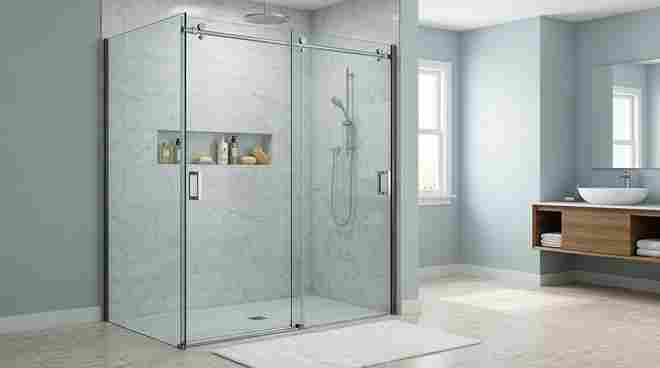
Sliding shower doors are shower enclosures where two or more glass panels slide horizontally along a track system rather than swinging open on hinges. They’re the standard choice for bathrooms where swing clearance is limited which covers the majority of urban bathrooms in Pakistan, the UK, and most apartment-style housing worldwide.
The practical advantage is real. A hinged shower door needs 24 to 30 inches of clear floor space to swing open. A sliding door needs zero. In a bathroom where the toilet is 18 inches from the shower edge, that difference is the entire decision.
They also tend to be more structurally stable over time than pivot doors in high-use settings, provided the hardware quality is adequate.
The Four Types of Sliding Shower Doors — and Which One Actually Fits Your Bathroom
Bypass Sliding Doors
The most common type. Two panels on parallel tracks one slides in front of the other. They work well in alcove showers where the entry is between two walls. The limitation is access width: you can only open half the door at a time, which matters when cleaning the enclosure or helping a child or elderly person bathe.
If your shower opening is under 60 inches wide, this is usually the right choice.
Frameless Sliding Doors
No metal frame around the glass edges. The panels are typically 3/8 to 1/2 inch thick tempered glass and rely on precision-machined hardware rollers and wall-mounted guides rather than an aluminum channel system. They look clean, collect less soap scum on frame edges, and are significantly easier to maintain.
The honest trade-off: frameless sliding doors cost considerably more than framed options, and they require walls that are genuinely plumb and level. In older properties and many construction projects in Pakistan and South Asia where walls are rarely perfectly true frameless installations require shimming and adjustment work that adds installation cost and time.
Semi-Frameless Sliding Doors
A middle ground. The outer frame is present, but the glass panels themselves have no internal framing. They’re more forgiving of wall imperfections than fully frameless designs, easier to seal properly at the edges, and sit in a sensible price range for most buyers.
For most residential bathrooms doing a first-time enclosure installation, semi-frameless is where value and performance meet.
Framed Sliding Doors
Full aluminum channel framing around every panel. The most affordable option, the easiest to install, and the most forgiving of uneven walls. The drawback is maintenance the metal channels collect soap residue and hard water deposits, and the rubber seals degrade over three to five years requiring replacement.
If budget is the primary constraint, framed is a completely valid choice. Go in knowing the cleaning and seal maintenance it requires.
Glass Types: The Specification Nobody Reads Until There’s a Problem
All shower door glass in a reputable product should be tempered (toughened) glass. This is not a premium feature. It’s a safety standard. Tempered glass, when it breaks, shatters into small blunt pieces rather than sharp shards. Annealed (standard) glass in a shower enclosure is a safety hazard.
Beyond tempering, the meaningful specifications are thickness and coating.
Glass thickness for sliding shower doors typically runs from 4mm on budget framed products to 10mm or 12mm on premium frameless designs. Thicker glass is heavier, which demands better hardware but also produces a noticeably more premium feel and better structural stability. For a frameless door, go no thinner than 8mm.
Low-iron glass, sometimes marketed as “ultra-clear” or “starphire” glass, has a noticeably cleaner appearance without the greenish tint that standard float glass shows at the edges. In a high-end bathroom renovation, this detail is visible and worth specifying.
Easy-clean nano-coating is a surface treatment that reduces water and soap adhesion. Quality versions genuinely reduce cleaning frequency. Cheap versions wear off within a year. Ask specifically for the brand of coating and whether it’s factory-applied or field-applied — factory application lasts considerably longer.
What Everyone Gets Wrong About Measuring for Sliding Shower Doors
This is where most failed installations begin.
Measure the opening at the top, middle, and bottom. Then measure the depth at multiple heights. Shower openings are almost never perfectly square walls bow, floors slope slightly toward the drain, and tile installation adds uneven thickness to walls. The smallest measurement in each direction is your working dimension.
Standard bypass sliding doors are available in widths from 44 inches to 60 inches in most markets. Custom sizing is available but adds lead time and cost. If your opening falls outside standard dimensions common in older homes or custom-built bathrooms factor custom manufacturing time into your project timeline.
Track clearance at the floor matters as well. The bottom track of a sliding door needs a level surface to function correctly. If your shower floor has a significant slope toward the drain in the track area, the door will not slide smoothly over time. A tile setter or installer can address this with leveling compound before the door goes in.
If you’re unsure about your measurements, bookmark the measurement checklist below and take it with you to the showroom.
The Measurement Checklist Before You Order Anything
- Measure opening width at top, middle, and bottom use the smallest number
- Measure opening height at left, center, and right sides
- Check walls with a level — note any bow or lean over the full height
- Confirm floor levelness across the full track width
- Measure available clearance outside the shower for door panel overlap
- Check tile thickness on walls it affects the final framed opening size
- Confirm the shower tray or base lip height some tracks require a specific reveal
- If replacing an existing door, note the current track mounting style
Take photos of every measurement point. A good supplier will ask for them.
Hardware Quality: The Difference Nobody Talks About Until the Rollers Fail
The glass is visible. The hardware is what determines whether the door works in five years.
Sliding shower door hardware rollers, brackets, wall profiles, and floor guides is under daily mechanical stress, constant humidity, and soap and water contamination. Cheap zinc alloy hardware corrodes and seizes. Stainless steel grade 304 is the minimum worth specifying. Grade 316 (marine grade) stainless is worth the premium in coastal climates or high-humidity environments.
Roller quality is the single component that most separates price tiers in frameless doors. Premium doors use nylon-wheeled or stainless-wheel rollers in precision-machined housings. Budget doors use pressed metal or low-grade plastic rollers that develop play within 18 to 24 months. Once the rollers develop play, the glass panels begin to wobble on the track and the door starts derailing or leaking at the seals.
Brands like RONA, Kohler, DreamLine, and VIGO in North American markets, and Merlyn and Matki in UK markets, produce hardware that lasts. In Pakistan, locally fabricated frameless systems vary dramatically in hardware quality specify stainless steel components explicitly and verify before installation.
What Does It Actually Cost — The Full Number, Not the Sticker Price
Basic framed bypass doors start from PKR 15,000 to 35,000 in Pakistan for standard sizes, or roughly $150 to $400 USD in North American markets. These numbers are approximate and shift with exchange rates, material costs, and supplier. Always verify current pricing directly with your supplier.
Semi-frameless options in Pakistan typically run PKR 40,000 to 90,000 depending on glass thickness and hardware quality. In the UK, equivalent products run £300 to £700.
Fully frameless sliding doors with 10mm glass and quality hardware: PKR 90,000 to 200,000-plus in Pakistan, $700 to $1,800 USD in North America, and £500 to £1,500 in the UK. These are product prices only.
Add installation labor: typically PKR 8,000 to 20,000 in Pakistan for a standard installation, and $150 to $350 USD or £120 to £250 in Western markets, depending on complexity.
Hidden costs worth accounting for: silicone sealant and professional sealing, any wall or floor leveling work required before installation, glass sealing treatment if not factory-applied, and replacement seals or wiper strips within three to five years on any product.
The total cost of a frameless sliding door installation done properly is consistently 40 to 60% higher than the product price alone. Budget for the full number.
Where Sliding Shower Doors Genuinely Fail — The Honest Trade-offs
Bypass sliding doors never give you full-width access. This matters for cleaning, for assisting someone in the shower, and for feel. If your shower is 60 inches wide and you’re used to a swing door, the reduced opening takes adjustment.
Bottom tracks collect water, soap, and hair. They require regular cleaning to prevent mold in the track channel. Frameless designs with a minimal floor guide rather than a full bottom track reduce this problem significantly but don’t eliminate it entirely.
Leakage at the overlap between panels is a persistent issue on lower-quality sliding doors when the magnetic seals or wiper strips degrade. This isn’t a failure of sliding doors as a category it’s a failure of cheap seals. Replace them at the first sign of water getting through and the problem stops.
Frameless doors on walls that aren’t truly plumb will develop alignment issues over time as the building settles. This isn’t a scare story it’s a real installation consideration in markets where construction tolerances are wide.
The Bottom Line Before You Buy
Sliding shower doors are the right choice for most bathrooms where swing clearance is a constraint, and the right choice for most renovation budgets when specified correctly.
The decisions that matter most are glass thickness, hardware quality, and accurate measurement in that order. Frameless or semi-frameless over framed wherever budget allows, because the maintenance difference over five years is substantial. Stainless steel hardware over zinc alloy, always.
Don’t order based on a showroom sample in ideal lighting. Ask for the hardware specification sheet, confirm the glass certification, and measure your opening three times before anything gets cut or ordered. Getting those steps right costs nothing. Getting them wrong costs the entire installation.
If you’re ready to move from research to selection, take the measurement checklist from this guide to your next showroom visit. It covers everything a supplier needs to give you an accurate quote.
FAQ
What is the best type of sliding shower door for a small bathroom? A bypass sliding door in a semi-frameless or frameless configuration is the best choice for small bathrooms. It requires no swing clearance, fits standard alcove shower openings from 44 to 60 inches, and in semi-frameless form offers easy cleaning without the full cost of frameless hardware.
Are frameless sliding shower doors worth the extra cost? For most buyers doing a quality renovation, yes. Frameless doors are easier to clean, hold up better over time with quality hardware, and look noticeably better in finished bathrooms. The premium is real but the maintenance savings and longevity difference over five-plus years typically justify it. The exception is a rental property or temporary installation where budget matters more than longevity.
What thickness of glass should I choose for a sliding shower door? A minimum of 6mm for framed doors and 8mm for semi-frameless. Fully frameless sliding doors should use 10mm glass at minimum. Thinner glass on frameless applications creates flex in the panel during use that puts stress on the hardware and seals over time.
How do I stop my sliding shower door from leaking? Check the wiper strips and magnetic seals at the panel overlap first — these degrade and should be replaced every two to three years. Verify the bottom track seal against the shower tray is intact. On frameless doors, check the silicone bead at the wall profiles. Most sliding door leaks are seal failures, not structural problems, and are inexpensive to fix.
Can I install a sliding shower door myself? A framed bypass door in a standard alcove opening is within DIY capability for someone comfortable with basic tools and accurate measuring. Frameless and semi-frameless installations involve heavier glass, precise wall fixings, and silicone work that benefits from professional installation. An incorrectly installed frameless door creates structural and safety risks.
What hardware should I look for in a quality sliding shower door? Stainless steel grade 304 as a minimum for all components in standard environments. Grade 316 for coastal or high-humidity settings. Nylon or stainless steel rollers in precision housings. Avoid zinc alloy or chrome-plated hardware where the base metal is exposed to water it corrodes within one to two years in shower environments.
How do I measure for a sliding shower door? Measure the opening width at the top, middle, and bottom, and use the smallest figure. Measure height at three points. Check that walls are plumb and floor is level across the full track width. Take photos and share them with your supplier. Never assume an opening is square — it almost never is.
What’s the difference between bypass and frameless sliding shower doors? Bypass refers to the sliding mechanism — two panels on parallel tracks. Frameless refers to the construction style — no metal channel around the glass edges. A frameless door can also be a bypass door. The terms describe different attributes: how it opens versus how it’s built.
How long do sliding shower doors last? Quality frameless or semi-frameless sliding doors with stainless steel hardware last 10 to 20 years with basic maintenance. The components that need attention are the rollers (every 5 to 8 years on quality hardware), wiper seals (every 2 to 3 years), and silicone sealant (every 3 to 5 years). Cheap framed doors with zinc hardware may need full replacement within 5 years.
What brands make the best sliding shower doors? In North American markets, DreamLine, VIGO, and Kohler are consistently well-reviewed for mid to premium residential use. In UK markets, Merlyn, Matki, and Lakes produce quality semi-frameless and frameless products. In Pakistan, reputable fabricators using imported hardware and certified tempered glass outperform most generic products — specify the hardware grade and glass certification before ordering.