
Kitchen Cabinets Katy TX
Kitchen Cabinets in Katy, TX: What to Know Before You Buy or Remodel
If you’re in Katy, Richmond, Sugar Land, or Cypress and thinking about new kitchen cabinets, you’ve already learned one thing: the options feel overwhelming. Semi-custom, stock, RTA, shaker, inset, frameless — the terminology alone can stall a decision for weeks. Worse, most local contractors quote wildly different numbers for similar work.
This guide cuts through the noise. It explains what drives cabinet costs in the Greater Houston market, how to tell a solid remodel from a cheap one, and what questions to ask any contractor before signing anything. Whether you’re doing a full kitchen gut or just replacing cabinet doors, the same decision logic applies.
What Kitchen Cabinets in Katy Actually Cost in 2026
Cabinet costs in the Katy–Houston corridor break into three tiers, and understanding them saves you from comparing quotes that aren’t measuring the same thing.
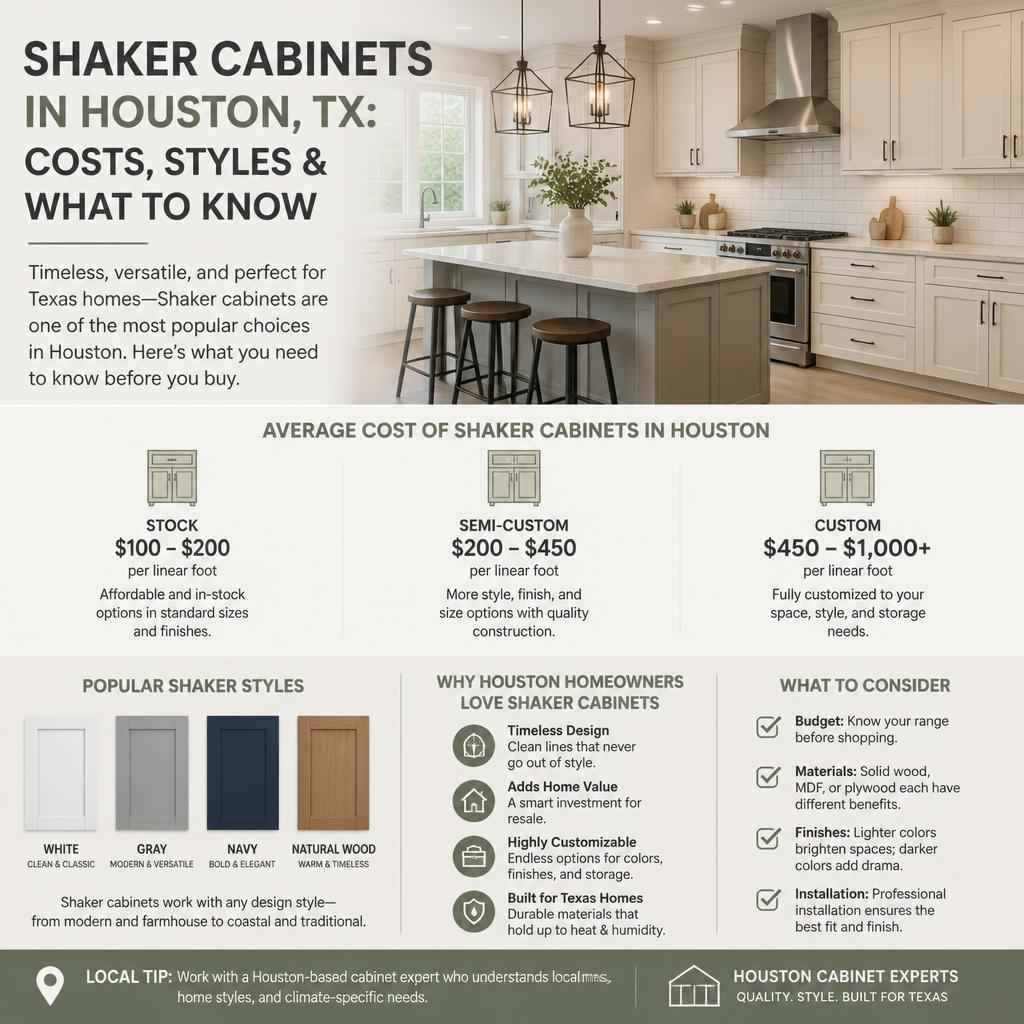
Stock cabinets — the kind available off the shelf at big-box retailers like Home Depot or IKEA — run roughly $60 to $200 per linear foot installed. They’re limited in size increments and finish options, but for rental properties or tight budgets, they work.
Semi-custom cabinets are where most Katy homeowners land. These are built to order from a set catalog of sizes and finishes, and they typically run $150 to $400 per linear foot installed. Lead times are 4–8 weeks. This range covers the vast majority of kitchen remodels in the $15,000–$45,000 budget window.
Custom cabinets — built from scratch to your exact dimensions and design — start at $500 per linear foot installed and can go well past $1,000 in luxury homes. In Sugar Land and the West Houston luxury corridor, this tier is more common than it might seem.
| Cabinet Tier | Installed Cost (Per Linear Foot) | Lead Time | Best For |
|---|---|---|---|
| Stock | $60–$200 | In stock / 1–2 weeks | Rentals, fast flips, tight budgets |
| Semi-custom | $150–$400 | 4–8 weeks | Most residential remodels |
| Full custom | $500–$1,200+ | 8–16 weeks | Luxury builds, unusual layouts |
Prices reflect 2026 Houston-area market averages. Always get itemized quotes and verify current pricing with your contractor.
One number most quotes leave out: countertops, hardware, and demo are usually separate. A $20,000 cabinet quote doesn’t include removing the old ones, patching drywall, or new pulls and hinges. Get a full scope of work in writing before comparing bids.
Shaker Cabinets vs. Other Styles: Which One Works in Katy Homes?
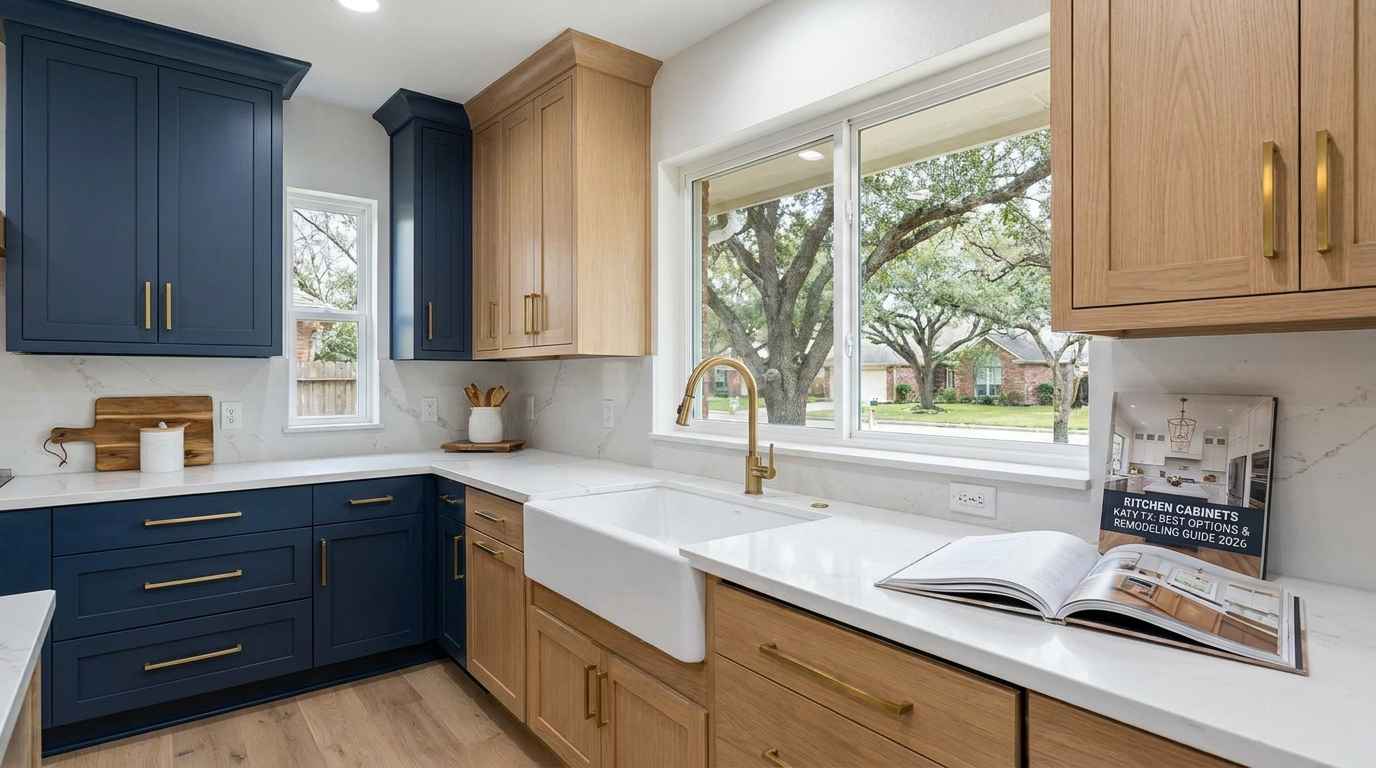
Shaker kitchen cabinets dominate the Houston suburban market for a practical reason: they pair with almost every countertop material, hardware style, and flooring choice. Their recessed-panel door is clean without being cold, which fits the transitional-style homes common in Katy, Cinco Ranch, and Cross Creek Ranch.
When Shaker Is the Right Call
Shaker works particularly well when you’re blending new cabinets with existing design elements — existing tile, flooring you’re keeping, or a layout that doesn’t allow for a full style overhaul. It’s also the most resale-neutral option if you’re planning to sell within five years. In the Katy–Richmond–Sugar Land market, buyers don’t penalize shaker; they expect it.
When to Consider Something Different
Flat-panel (slab) cabinet doors read more modern and work well in newer construction in Cypress and newer Katy subdivisions where the architecture leans contemporary. Raised-panel doors are more traditional and show up frequently in older Sugar Land and Richmond homes where buyers or owners prefer a more formal kitchen aesthetic.
The honest trade-off: flat-panel cabinets show fingerprints, dings, and cabinet misalignment more visibly than shaker. In households with kids or high kitchen traffic, shaker’s recessed panel hides daily wear more forgivingly.
How to Evaluate Kitchen Remodeling Contractors in the Katy Area
Finding a kitchen remodeling contractor in the Houston Land area isn’t the hard part. Finding one worth trusting is.
In the Katy–Cypress–Sugar Land market, the contractor landscape ranges from licensed general contractors with dedicated design teams to one-man operations buying materials from the same stores you could walk into yourself. Both can produce good work. The difference is in accountability, timeline reliability, and what happens when something goes wrong mid-project.
The Five Questions That Separate Good Contractors From the Rest
- Are you licensed and insured in Texas? General contractors in Texas aren’t required to hold a state license (unlike electricians and plumbers), but a reputable remodeling contractor will carry general liability insurance and workers’ compensation. Ask for the certificate, not just the answer.
- Who does the actual installation work? Some contractors sub out cabinet installation to crews they don’t directly supervise. That’s not automatically a problem, but you should know who’s in your house and whether the GC will be on-site during critical phases.
- What’s the payment schedule? A red flag: any contractor asking for more than 30–40% upfront before materials are ordered. Industry-standard for kitchen remodels in Texas is a deposit to start, a draw when cabinets arrive, and final payment at completion.
- Can I see a project similar to mine, in person or in photos with references I can call? Portfolio photos on a website are marketing. References you can actually call are evidence.
- What’s your lead time right now, and what causes delays on most of your jobs? An honest contractor will tell you. An overselling one will tell you what you want to hear.
Your Dream Remodeling: What a Full Kitchen Remodel Looks Like End to End
A complete kitchen remodel in Katy — from demo to final punch list — typically runs 4 to 10 weeks depending on scope, cabinet lead times, and how quickly decisions get made. Here’s a realistic project sequence:
- Design and selection (Week 1–2): Cabinet style, finish, hardware, and layout confirmed. Countertop material selected. This phase often takes longer than homeowners expect because changes here cascade into cost and schedule changes downstream.
- Permits and ordering (Week 2–3): Good contractors pull permits when required. Cabinet orders are placed. This is when the real lead time clock starts.
- Demo and rough work (Week 4–5): Existing cabinets removed, any plumbing or electrical work relocated, drywall repaired.
- Cabinet installation (Week 5–7): Cabinets set and leveled. This is where layout problems — out-of-square walls, unexpected pipe locations — become apparent.
- Countertop template and install (Week 7–8): Countertops are templated after cabinets are set and installed 1–2 weeks later.
- Finishing (Week 8–10): Backsplash, hardware, appliances reconnected, touch-up paint, final walkthrough.
The most common reason kitchens run over schedule: homeowners change selections mid-project or approve a cabinet order before finalizing the layout. Lock in your decisions before demo starts.
Serving Katy, Richmond, Cypress, and Sugar Land: What Changes by Location
Most kitchen remodeling contractors operating in the Greater Houston area serve a broad radius, but there are practical differences by geography that affect your project.
Katy and Cinco Ranch homes tend to be newer construction (2000s–2020s), which typically means standard ceiling heights, more uniform cabinet dimensions, and faster installation. The trade-off is that many of these homes have builder-grade cabinets that are fully functional but have limited style range — a semi-custom replacement delivers a visible upgrade at a reasonable cost-to-value ratio.
Sugar Land has a wider mix of home ages and styles. Older sections have non-standard kitchen footprints that may require more custom work. Home values in parts of Sugar Land also support a higher cabinet investment — spending $40,000 on cabinets in a $700,000 home makes financial sense in a way it might not in a smaller market.
Richmond and Rosenberg are seeing more kitchen remodel activity as property values have risen. Cost sensitivity tends to be higher here, which makes semi-custom cabinets — especially ready-to-assemble (RTA) options from quality manufacturers — a more common solution than in Sugar Land proper.
Cypress has a strong base of newer homes with open-concept kitchens, which means cabinet layouts often include large island runs and taller uppers (42″ is standard). Frameless European-style cabinetry is more common here than in other parts of the Houston metro.
| Area | Typical Home Age | Common Cabinet Tier | Notes |
|---|---|---|---|
| Katy / Cinco Ranch | 2000s–2020s | Semi-custom | Builder-grade replacement common |
| Sugar Land | Mixed (1980s–2020s) | Semi-custom to custom | Higher price-point homes support larger budgets |
| Richmond / Rosenberg | Mixed | Stock to semi-custom | Cost-conscious; RTA popular |
| Cypress | 2000s–2020s | Semi-custom; some frameless | Open-concept layouts; taller uppers |
The Remodeling Mistakes Katy Homeowners Make Most Often
Even well-researched buyers make the same mistakes. These aren’t obvious — they’re the kind that show up three months after the project ends.
Buying cabinets and countertops from separate vendors without coordinating dimensions. Countertop overhangs, sink cutouts, and seam placement all depend on cabinet layout. When two vendors work independently, gaps appear — literally.
Choosing finish based on showroom lighting. A white shaker cabinet in a bright showroom under LED lighting reads very differently than the same door under warm incandescent lighting in your Katy kitchen. Always bring a sample home before finalizing.
Skipping the interior cabinet organization planning. Pull-out shelves, drawer dividers, and lazy Susans are far cheaper to include during a remodel than to retrofit afterward. Most contractors won’t bring this up unless you ask. Think through how you actually use your kitchen before the order is placed.
Under-budgeting for the “everything else.” A rule of thumb used in the Houston remodeling market: cabinets typically account for 40–50% of a full kitchen remodel budget. If your cabinet quote is $20,000, your full project is more likely $40,000–$50,000 when you add countertops, backsplash, appliances, flooring, lighting, and labor.
How to Start Your Kitchen Cabinet Project in Katy
The clearest next step depends on where you are in the process.
If you’re still in research mode, start by visiting two or three local showrooms to see cabinet quality in person. Photos don’t convey box construction, drawer glide quality, or finish depth. Your Dream Remodeling and other Katy-area kitchen specialists typically offer design consultations — use them to pressure-test your budget before committing to anything.
If you’re ready to get quotes, line up at least three bids and make sure each one covers the same scope of work. Ask each contractor to itemize cabinets, labor, countertops, and demo separately so you can compare them accurately.
One practical move that most homeowners skip: before your consultation, measure your current kitchen — wall lengths, ceiling height, window and door placement — and take photos of every wall. Contractors who can see your space before the first meeting will give you more accurate initial guidance.
Conclusion
New kitchen cabinets in Katy, Richmond, Sugar Land, or Cypress are one of the highest-return investments in a Texas home — but only when the selection, contractor, and budget are aligned. Semi-custom shaker cabinets hit the best value point for most homeowners in this market. The real work is choosing a contractor who will communicate honestly, hold their schedule, and back their installation with a warranty that means something.
If you’re getting ready to move forward, the best version of that process starts with a design consultation — not a showroom visit where someone sells you upgrades. Get the scope right, then lock in the details. A kitchen done well in Katy lasts 20 years without regret.
The right cabinet decision isn’t the most expensive one. It’s the one that fits your home, your household, and your timeline.
FAQ SECTION
Q: How much does a kitchen cabinet remodel cost in Katy, TX? Most kitchen cabinet remodels in Katy run between $15,000 and $50,000 fully installed, depending on cabinet tier, kitchen size, and whether countertops and demo are included. Semi-custom cabinets are the most common choice in this market, typically landing between $150 and $400 per linear foot installed. Always get itemized quotes — a low total bid often leaves out demo, permits, or countertop work. Verify current pricing directly with your contractor, as material and labor costs shift with market conditions.
Q: What are shaker kitchen cabinets and why are they popular in Houston? Shaker cabinets feature a five-piece door with a flat recessed center panel and a simple frame. They’re the dominant style in Houston-area homes because they work with nearly any countertop, hardware, or flooring choice, making them low-risk for resale. Their clean profile fits both traditional and contemporary kitchens. In the transitional-style homes common in Katy and Cinco Ranch, shaker is the default choice for new and replacement cabinetry.
Q: How do I find a reliable kitchen remodeling contractor in Katy or Cypress? Start by asking for a Texas general liability insurance certificate, not just confirmation that they’re insured. Ask who physically does the installation — the contractor’s crew or a sub. Request references from projects similar to yours in the Katy–Cypress–Sugar Land area and actually call them. Get at least three bids with itemized scopes of work, and avoid any contractor who asks for more than 40% upfront before materials arrive.
Q: What’s the difference between stock, semi-custom, and custom kitchen cabinets? Stock cabinets are pre-built in fixed sizes, available immediately, and cost the least — roughly $60–$200/linear foot installed. Semi-custom cabinets are built to order from a manufacturer’s catalog with more size and finish options, costing $150–$400/linear foot with a 4–8 week lead time. Custom cabinets are built to your exact specifications by a cabinet shop, starting around $500/linear foot and taking 8–16 weeks. Most Katy homeowners use semi-custom for the balance of quality, flexibility, and cost.