Refacing Kitchen Cabinets
What Is Refacing Kitchen Cabinets — And Is It Worth It?
Your kitchen cabinets are structurally fine. The doors look dated, the finish is peeling, and you’re tired of looking at them — but the boxes themselves are solid. Full replacement feels like overkill and $25,000 you don’t want to spend. Cabinet refacing sits squarely between a fresh coat of paint and a full gut job, and for the right kitchen, it delivers serious results. But it’s not the right call for every situation. This guide covers what refacing actually involves, what it costs in 2026, where it beats replacement, and the specific cases where it doesn’t.
What Does Refacing Cabinets Mean, Exactly?
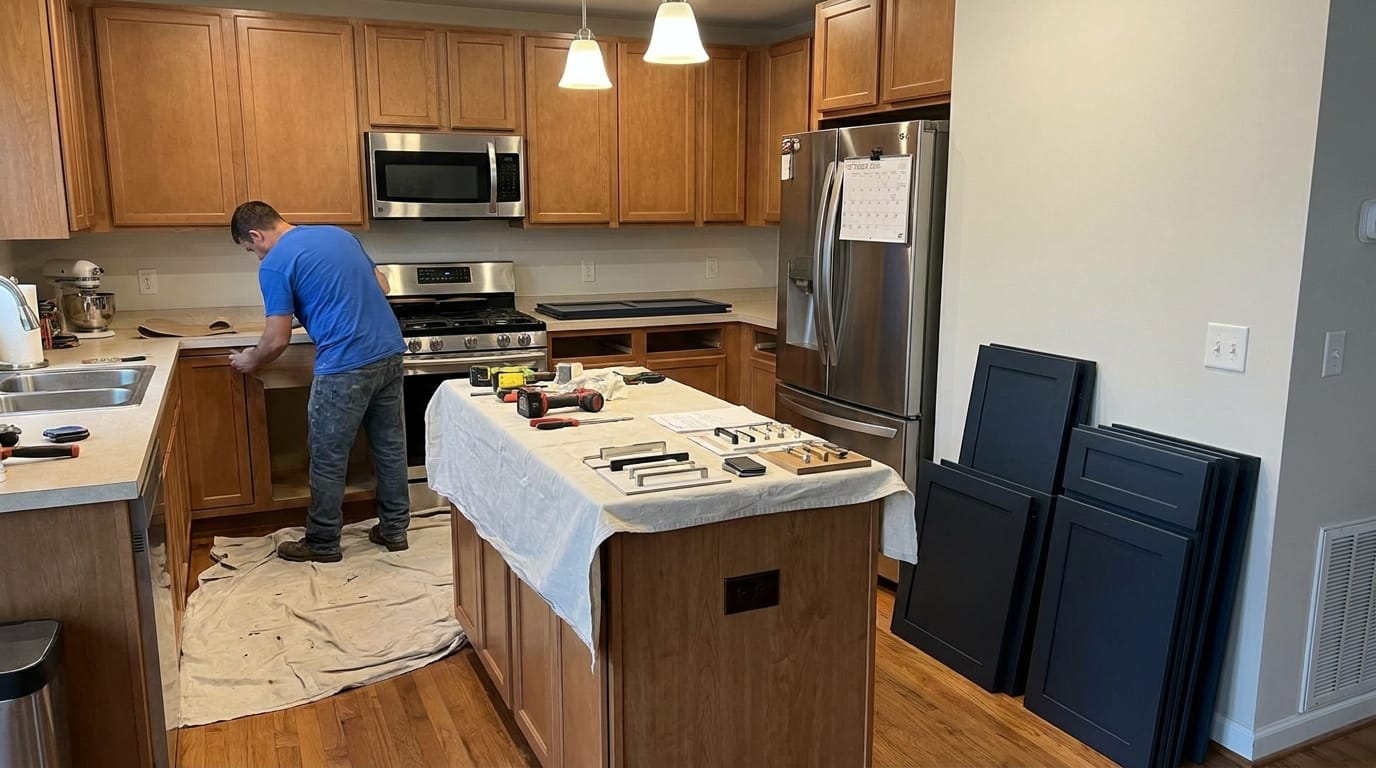
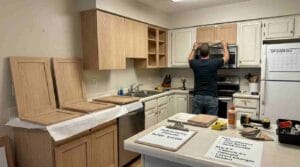
Cabinet refacing is the process of replacing the visible surfaces of existing cabinets while keeping the structural boxes (the carcasses) in place. That means new doors, new drawer fronts, and a new veneer or laminate skin applied over the existing cabinet frames. Hardware — hinges, pulls, handles — is typically replaced at the same time.
The result looks like a brand-new kitchen. The layout stays identical.
What refacing does not change: the cabinet layout, interior storage configuration, box depth, or the position of any upper or lower cabinet. If your kitchen has a functional problem — not enough storage, an awkward corner, poor flow — refacing won’t fix it. That distinction matters more than most articles admit.
How Much Does Refacing Kitchen Cabinets Cost in 2026?
Professional kitchen cabinet refacing typically runs between $4,000 and $14,000 for an average-sized kitchen, with most homeowners landing in the $7,000–$10,000 range. The wide spread reflects three main variables: kitchen size, material choice, and regional labor rates.
Cost Breakdown by Component
| Component | Cost Range (Per Kitchen) |
|---|---|
| New cabinet doors (10–15) | $1,200 – $4,500 |
| Drawer fronts (8–12) | $400 – $1,200 |
| Veneer or laminate for frames | $800 – $2,500 |
| Labor (installation) | $1,500 – $4,000 |
| New hardware (optional) | $200 – $800 |
| Total (professional) | $4,000 – $14,000 |
Cost by Material Type
| Material | Cost per Linear Foot | Durability | Best For |
|---|---|---|---|
| Rigid thermofoil (RTF) | $45 – $75 | Moderate | Budget-conscious buyers |
| Wood veneer | $65 – $110 | Good | Traditional and transitional styles |
| Solid wood doors | $90 – $150+ | Excellent | High-end finishes |
| Laminate (like Formica) | $40 – $70 | Good | Modern, flat-front styles |
Prices reflect 2026 U.S. market averages. Always verify current pricing with your contractor or supplier, as material costs have remained volatile since 2022.
Refacing vs. Painting vs. Full Replacement
| Option | Average Cost | Lifespan | Changes Layout? | DIY-Friendly? |
|---|---|---|---|---|
| Cabinet painting | $1,200 – $4,500 | 5–8 years | No | Partially |
| Cabinet refacing | $4,000 – $14,000 | 10–15 years | No | Partially |
| Full replacement | $12,000 – $35,000+ | 20–30 years | Yes | No |
Cabinet refacing costs roughly 40–50% less than full replacement, according to data from the National Kitchen and Bath Association (NKBA). The trade-off is that you’re locked into your current layout and can’t upgrade interior box quality.
When Refacing Kitchen Cabinets Actually Makes Sense
Not every kitchen is a good candidate. Before getting quotes, check your situation against these conditions.
Refacing works well when:
- Your cabinet boxes are solid, square, and free of water damage or rot
- You’re satisfied with the current layout and storage volume
- You want a significant visual upgrade without the disruption of full replacement
- You plan to stay in the home for at least 5–10 years
- Your existing cabinets are a standard size that matches available door styles
For homeowners in mid-range markets — a $350,000–$500,000 home where the kitchen is dated but functional — refacing often delivers the best return. You’re not over-investing in a renovation that won’t recoup its cost at resale, and you’re not leaving obvious money on the table by painting over a peeling finish.
When to Skip Refacing and Replace Instead
This is the section most competitor articles either skip entirely or treat as a footnote. It shouldn’t be.
Do not reface if:
- The boxes are compromised. Particleboard cabinets that have absorbed moisture will sag, swell, or delaminate. Refacing a damaged box is throwing good money after bad — within two to three years, the structural failure shows through the new surface.
- You hate the layout. Refacing changes how your cabinets look. It does not move them. If you’ve always wanted an island where a peninsula sits, or you need deeper upper cabinets, refacing solves nothing.
- The existing doors are a non-standard size. Older kitchens sometimes have cabinets built to non-standard dimensions. Sourcing doors to fit costs significantly more, and the math starts to favor replacement.
- You’re planning a full kitchen renovation anyway. If the countertops, flooring, and appliances are all getting replaced, the cost difference between refacing and full cabinet replacement narrows enough that you should price both seriously.
- The existing veneer is already delaminating. New veneer applied over failing old veneer is a cosmetic fix that won’t last.
In our review of common remodeling scenarios, the single most frequent mistake homeowners make is choosing refacing because it sounds cheaper — without first checking the cabinet box condition. A $7,000 refacing job on cabinets with soft, water-swollen particleboard frames is money gone.
Refacing Laminate Cabinets: A Specific Case Worth Addressing
Older kitchens often have cabinets finished in laminate — the smooth, hard surface common in homes built between the 1970s and 1990s. Refacing laminate cabinets is doable, but it requires extra prep.
New veneer or laminate won’t adhere properly to a glossy existing surface without sanding or a chemical degloss treatment. If the existing laminate is peeling or lifting, those areas need to be addressed before new material goes on top. A contractor who glosses over this step is setting up a failure within three to five years.
Solid wood veneer over an old laminate frame works best when the existing laminate is still fully adhered and the surface is properly scuffed. RTF (rigid thermofoil) doors are a popular modern replacement for the dated flat-slab look common in older laminate kitchens, and they pair well visually with a clean, refaced laminate frame.
DIY Refacing Kitchen Cabinets: Honest Assessment
DIY cabinet refacing kits exist. Some homeowners pull it off well. Many don’t.
The door and drawer front swap is genuinely manageable for a competent DIYer — it’s mostly drilling, hinge alignment, and hardware installation. The harder part is applying veneer or contact paper to the cabinet frames without visible bubbles, misaligned seams, or lifting edges.
What DIY refacing realistically costs:
- Peel-and-stick veneer or contact paper: $150–$500
- New doors and drawer fronts (unfinished or pre-finished): $500–$1,800
- Hardware: $100–$400
- Tools (if you don’t own them): $50–$200
- Total DIY range: $800–$2,900
The gap between a professional job and a DIY job is most visible at the seams, corners, and door edges. If precision finishing isn’t your strength, the result can look like what it is — an amateur attempt at a professional service.
Micro-action: If you’re comparing DIY versus pro, price out a professional quote first. Many refacing contractors offer free consultations, and knowing the professional cost makes your DIY decision much more informed.
One scenario where DIY refacing does make sense: you’re replacing only the doors and drawer fronts, leaving the frame veneer in place. If the frame finish is still in decent condition and you’re just updating the door style, this is a straightforward weekend project with a high success rate.
Bathroom Cabinet Refacing: Same Process, Different Scale
Bathroom vanity refacing follows the same principles as kitchen cabinet refacing, but it’s almost always less expensive because of scale. A typical bathroom vanity refacing project — two doors, two drawer fronts, and a frame wrap — runs between $800 and $2,500 professionally.
Moisture exposure is a bigger concern in bathrooms. Solid wood veneer and certain MDF door styles are more vulnerable to humidity than RTF or laminate. For bathroom applications, RTF or a moisture-resistant MDF with a painted finish is generally the smarter material choice.
How to Find a Reputable Cabinet Refacing Contractor
Finding cabinet refacing companies near you is straightforward. Finding a good one takes more care.
Checklist before hiring:
- Verify they specialize in refacing, not just general carpentry. Ask how many refacing jobs they’ve completed in the past year.
- Request a physical sample of the veneer or laminate they use. Feel it. Look at the edge finishing.
- Get at least three quotes. Cost variance of 30–40% between contractors is normal for this work.
- Ask specifically how they prepare the existing cabinet surface before applying new veneer.
- Check reviews on Google, Houzz, or the Better Business Bureau — not just on the contractor’s own website.
- Ask for a written warranty on both materials and labor. Reputable contractors offer at minimum a one-year labor warranty; better ones offer three to five years.
As of 2026, the home renovation market has seen a notable increase in smaller specialty contractors offering cabinet refacing services, partly driven by demand from homeowners who went through full kitchen renovations during 2020–2022 and are now looking for more targeted updates. That’s good for price competition. It also means more inexperienced operators are in the market — which makes due diligence more important, not less.
Micro-action: Get your quotes in writing with a full scope of work, including which components are being replaced versus covered. “Refacing” means different things to different contractors.
Before and After: What Cabinet Refacing Realistically Delivers
The before-and-after photos you see in refacing marketing are usually accurate — the visual transformation is genuine. A kitchen with dated oak raised-panel doors in a honey stain can look completely different with white shaker-style doors and matte black hardware.
What the photos don’t show is the interior. Open those new cabinet doors, and you’ll still see the original box interior — the color, the finish, the old shelf pins. For some homeowners, this is completely fine. For others, it breaks the illusion. Adding interior liner paper or painting the interior boxes is an option, but it adds cost and labor.
The other thing the photos don’t show is what happens five years later. Materials matter. RTF doors can peel at the edges in high-heat environments (near ovens or dishwashers). Wood veneer can crack in very low-humidity conditions. A solid-wood door, properly finished, will outlast both.
Conclusion
Cabinet refacing delivers real value in a specific scenario: solid boxes, sound structure, a layout you like, and a budget that doesn’t justify full replacement. Done well with quality materials and a competent contractor, a refaced kitchen can look genuinely new and hold up for a decade or more.
The mistake worth avoiding is choosing refacing by default because it sounds less expensive. Check the cabinet boxes first. Verify your layout works for your life. Price the professional option before going DIY. And if you’re near the cost crossover with full replacement, get quotes for both before committing.
Your Dream Remodeling and similar specialty refacing companies can provide in-home assessments that take the guesswork out of the material and condition questions. Start there — a thirty-minute consultation is worth more than three hours of online research when you’re dealing with your specific cabinets, your kitchen, and your budget.
The right choice depends on what you’re working with. Now you have what you need to figure that out.
FAQ SECTION
What is refacing kitchen cabinets? Cabinet refacing means replacing the visible surfaces of your existing cabinets — doors, drawer fronts, and the veneer on the cabinet frames — while keeping the structural boxes in place. The kitchen layout stays the same. The result looks like a brand-new kitchen at roughly half the cost of full replacement.
How much does refacing kitchen cabinets cost? Professional refacing typically runs $4,000 to $14,000 for an average kitchen, with most projects landing between $7,000 and $10,000. Cost depends on kitchen size, material choice (RTF, wood veneer, solid wood), and regional labor rates. Always get a written quote that breaks out materials and labor separately.
Is refacing cabinets worth it? For most homeowners with structurally sound cabinets and a functional layout, yes. You get a significant visual upgrade at 40–50% less than full replacement. It’s not worth it if the cabinet boxes are damaged, if you dislike your current layout, or if a full renovation is already planned.
How long does cabinet refacing last? With quality materials and professional installation, cabinet refacing typically lasts 10 to 15 years. Solid wood doors last longer than RTF; RTF can peel at edges near heat sources. The frame veneer usually lasts as long as the doors if applied correctly.
Can I reface laminate kitchen cabinets? Yes, but proper surface prep is essential. The existing laminate must be sanded or chemically deglossed so the new veneer adheres properly. If the existing laminate is already peeling or lifting in spots, those areas must be repaired first. A contractor who skips prep is creating a short-term fix.
What is the difference between cabinet refacing and painting? Painting covers the existing surface with paint. Refacing replaces the doors, drawer fronts, and applies new veneer to the frames. Refacing costs more but lasts longer and allows for material, style, and texture changes that paint can’t achieve. Painting is better for short-term budgets or when the existing door style is acceptable.