You’ve been researching kitchen cabinets for weeks. Every showroom calls something “contemporary.” Every blog repeats the same five bullet points. But nobody actually explains what the word means, what separates a $200 cabinet from a $600 one, or when the whole look just won’t work in your home.
That’s what this guide is for.
By the end, you’ll know exactly what makes a cabinet contemporary, which materials hold up and which ones don’t, what a realistic budget looks like in 2026, and the questions to ask before you spend a single dollar.
What Does “Contemporary” Actually Mean?
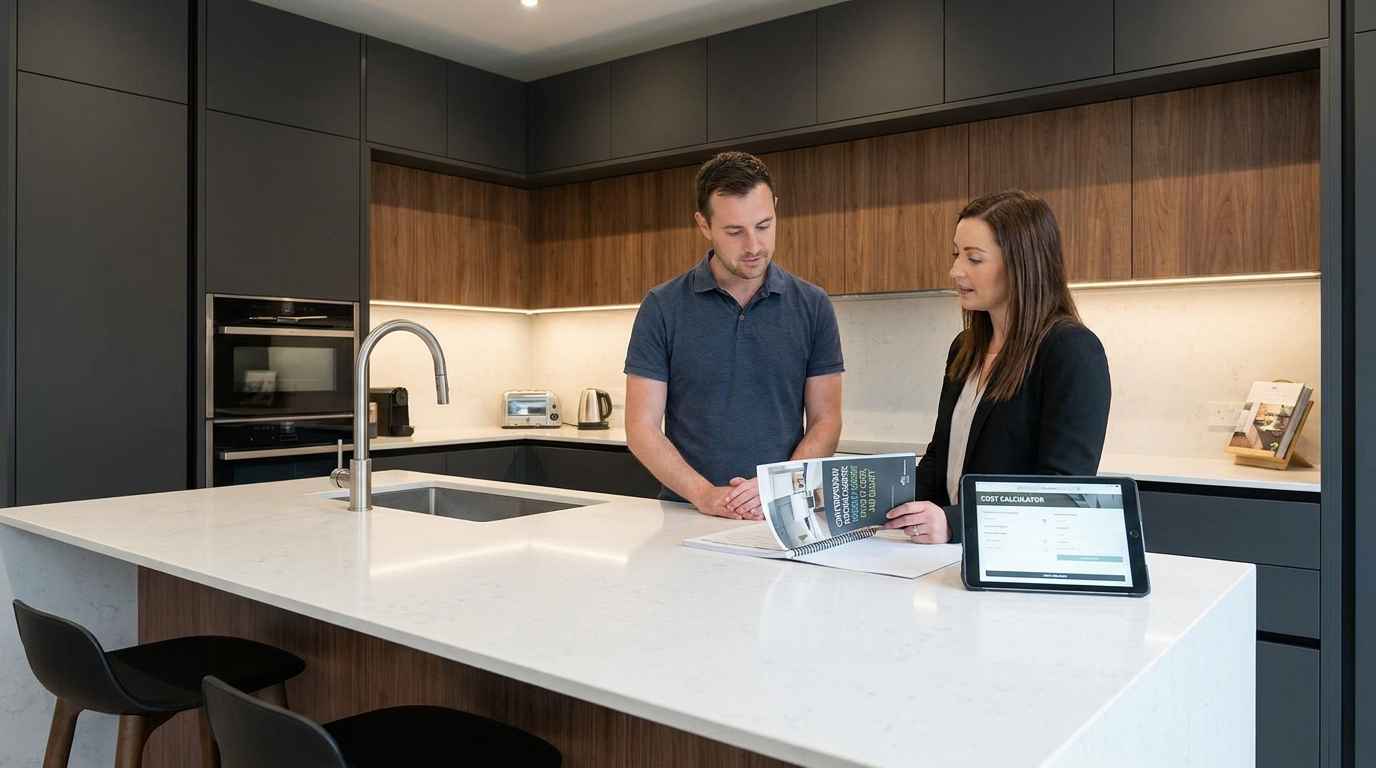
Contemporary kitchen cabinets are defined by clean lines, flat or minimally detailed doors, and hardware that feels architectural rather than decorative. No carved panels. No ornate handles. No fussy trim.
The word “contemporary” literally means “of the present time.” So in 2026, it refers to what’s popular and considered stylish right now — not a fixed era or movement.
Here’s where most people get confused:
Contemporary is NOT the same as modern.
Modern (as a design term) refers to mid-century modern — the style from roughly the 1940s to 1970s, with warm teak and walnut woods, tapered legs, and organic curves. Contemporary is whatever is current today. In practice, they can overlap, but they are not the same thing. A showroom calling flat-white cabinets “modern” is technically wrong. They’re contemporary.
The Three Things That Make a Cabinet Contemporary
- Flat or simple doors Full slab doors — completely flat, no frame, no raised panel — are the defining feature. A slim shaker door with a tight, minimal frame also qualifies. What doesn’t qualify: raised panel doors, detailed molding, decorative carving, or anything that looks like it belongs in a colonial farmhouse.
- Clean, architectural hardware Long bar pulls in matte black or brushed nickel. Integrated pulls built into the door edge. Or no visible hardware at all with push-to-open systems. The moment you add ornate cup pulls, vintage brass knobs, or anything that looks like jewelry, you’ve left contemporary territory.
- A tight color palette Two colors maximum — usually a lighter upper cabinet and a darker or wood-tone lower cabinet. This combination (called two-tone) has been the most requested kitchen configuration in the US for three straight years, according to the National Kitchen & Bath Association’s 2025 Design Trends Report. Or a single color throughout in two different finishes — matte uppers, gloss lowers.
That’s it. If a cabinet has those three things, it’s contemporary.
Contemporary vs. Shaker vs. Modern — What’s the Difference?
People mix these terms constantly. Here’s a simple breakdown:
Style — What it looks like — What era it comes from
Contemporary — Flat slab doors, minimal hardware, tight palette — Right now (always changing) Shaker — Simple recessed panel, clean lines — 19th century Shaker movement Modern / Mid-century — Warm woods, tapered legs, organic shapes — 1940s–1970s Traditional — Raised panels, ornate details, decorative hardware — Timeless / classic
You can have a contemporary kitchen with shaker-style doors — as long as the shaker profile is slim and minimal. A chunky, detailed shaker door leans traditional.
The safest way to think about it: contemporary is a vibe, not a fixed style. It’s whatever reads as clean, current, and unfussy today.
Contemporary Kitchen Cabinets:
Cabinet Construction — This Is What Actually Matters
The door style is what catches your eye. The box construction is what determines whether your cabinets last 8 years or 25.
Most buyers focus entirely on how cabinets look and ignore how they’re built. That’s the most expensive mistake you can make.
Frameless vs. Face-Frame
Contemporary cabinets are almost always frameless (also called European-style). There’s no wood frame on the front of the box — the door attaches directly to the cabinet sides. This gives you a flush, clean front and slightly more usable interior space.
Traditional American cabinets use a face-frame — a solid wood border that covers the front of the box. It reduces interior width by about 1 to 1.5 inches per cabinet and creates visible lines on the cabinet front.
Frameless looks cleaner. But it’s less forgiving. In older homes with walls that aren’t perfectly plumb and level — especially anything built before 1970 — face-frame installation is more forgiving and easier to adjust. A skilled installer can make frameless work anywhere, but the margin for error is tighter.
If you’re renovating an older home, ask your installer about this specifically before deciding.
Plywood Box vs. Particleboard Box
This is the single most important construction question you can ask.
Plywood boxes: — Hold screws and hinges firmly, even after years of use — Resist moisture and humidity well — Don’t swell or warp when they get wet near dishwashers and sinks — Last significantly longer
Particleboard boxes: — Are cheaper to manufacture — Work fine in very dry conditions — Start to swell and fail at edges within 3–5 years if they get wet — Lose their grip on screws and hinges over time
Most semi-custom and custom cabinet lines use plywood boxes. Most stock cabinets from big-box stores use particleboard. Suppliers don’t always advertise this clearly — vague phrases like “premium engineered wood” almost always mean particleboard.
Ask directly. It’s a reasonable question and a reputable supplier will answer it without hesitation.
Cabinet Finishes — What Holds Up and What Doesn’t
The finish on your cabinet doors affects how the kitchen looks, how it cleans, and how long it stays looking good. Here’s an honest comparison of the most common options.
Thermofoil / PVC wrap This is a thin vinyl film wrapped around an MDF door. It’s the most common finish in budget and entry-level cabinets.
The honest truth: it looks great in the showroom and in photos. In real kitchens, edges start to lift and peel near the dishwasher and range within 3 to 7 years. It can’t be repaired — once it starts peeling, the door needs replacing. Fine for a rental property or a short-term remodel. Not ideal for a kitchen you plan to keep.
Painted MDF or Painted Wood A properly primed and painted door looks crisp and clean. It chips at edges over time, especially near high-traffic areas, but chips can be touched up. Mid-range durability. Good option for most primary homes.
Lacquered Wood A high-quality lacquer finish — sprayed and cured professionally — is durable, easy to clean, and looks refined. It requires careful cleaning (no abrasive scrubbers) but holds up well in family kitchens. More expensive than painted MDF but the longevity justifies the cost.
Wood Veneer A thin layer of real wood over an engineered core. Gives you the warmth and grain of natural wood without the price of solid wood. High durability with proper finishing. Needs occasional conditioning to maintain the wood. Very popular in two-tone contemporary kitchens as the lower cabinet material.
High-Pressure Laminate (HPL) Often misunderstood as “cheap,” HPL at the quality tier (brands like Formica or Wilsonart at the high end) is actually one of the most durable finishes available. Resistant to scratches, moisture, and heat. Easy to clean. Consistent color and texture. Wide range of price points — stock laminates are budget-friendly, premium HPL rivals lacquer in cost. Best overall durability for busy family kitchens.
Quick guide: Budget remodel or rental → Thermofoil Primary home, mid-range budget → Painted MDF or Painted Wood High-use family kitchen → High-pressure laminate or Lacquered wood Warm contemporary aesthetic → Wood veneer (lower cabinets) with painted or lacquer uppers
What Do Contemporary Kitchen Cabinets Actually Cost in 2026?
Most guides either give you a range so wide it’s useless or skip cost entirely. Here’s a realistic breakdown.
Cabinet cost by tier (US market, 2026):
Stock cabinets: $75–$175 per linear foot Examples: IKEA SEKTION, Home Depot Hampton Bay Best for: Rental properties, tight budgets, short-term renovations
Semi-custom cabinets: $175–$500 per linear foot Examples: KraftMaid, Medallion, Fabuwood, Aristokraft Best for: Most primary home renovations, mid-market budgets
Custom cabinets: $500–$1,500+ per linear foot Examples: Plain & Fancy, Christopher Peacock, local custom cabinet shops Best for: High-end renovations, non-standard room dimensions, specific design requirements
For a standard 10×10 kitchen (the industry benchmark, measuring 20 linear feet of cabinets): — Stock: roughly $1,500 to $3,500 — Semi-custom: roughly $3,500 to $10,000 — Custom: $10,000 to $30,000 and up
These numbers cover cabinets only. Your full renovation budget also needs to account for: — Countertops — Installation labor ($50–$120 per hour depending on your US market) — Hardware (pulls, hinges) — Any plumbing or structural work
Important: prices vary by region, supplier, and project scope. Always get quotes from at least two contractors specific to your area. The figures above reflect general US market conditions as of early 2026.
Should You Reface Instead of Replace?
If your existing cabinet boxes are structurally solid — no moisture damage, no sagging — you may not need full replacement to get a contemporary look.
Cabinet refacing replaces just the doors, drawer fronts, and hardware while keeping the existing boxes. It can achieve a convincing contemporary result at roughly 40 to 60 percent of the cost of full replacement.
Good candidate for refacing: kitchen under 15 years old, plywood boxes in good condition, layout you’re happy with. Not a good candidate: particleboard boxes with water damage, layout that doesn’t work for your needs, or cabinets older than 20 years.
The Questions to Ask Before You Buy
Most cabinet regrets come down to one of three things: a finish that fails too soon, a construction quality that doesn’t match the price, or lead times that derail the renovation schedule.
These five questions will surface problems before you commit:
- Is the box plywood or particleboard? If the answer is vague — “premium engineered wood,” “high-density composite” — that usually means particleboard. Ask again, directly.
- What’s the drawer box made of and what slide system does it use? The quality benchmark is a dovetail-jointed drawer box with solid wood or plywood sides, paired with soft-close undermount slides (Blum Tandem is the most recognized brand). Stapled drawer boxes with side-mount slides are common in budget lines and wear out noticeably faster.
- What does the warranty actually cover? Many cabinet warranties exclude finish delamination — meaning the most common failure mode isn’t covered. Read the warranty or ask specifically.
- What’s the real lead time? Semi-custom typically runs 4 to 8 weeks. Custom can run 8 to 16 weeks or more. Any supplier quoting less than 3 weeks for “semi-custom” is likely selling you relabeled stock. Plan your renovation timeline around the real delivery date.
- Can I get a physical sample of the door and finish? Color reads completely differently under kitchen lighting vs. showroom lighting. Never commit to a finish without holding a physical sample under your actual kitchen lights. A reputable supplier will provide samples without hesitation.
When Contemporary Cabinets Are the Wrong Choice
This is the honest part that most kitchen design articles skip.
Contemporary style doesn’t work everywhere. Here are three situations where a different direction makes more sense.
Older homes with strong architectural character A fully flat slab door in a 1920s Craftsman bungalow or a Victorian rowhouse creates visual conflict. The clean contemporary face clashes with the period trim, ceiling details, and proportions of the room. A transitional style — slim shaker, minimal profile, simple hardware — bridges the gap much more successfully. You get a clean, updated look without fighting the architecture.
Tight budget with high durability expectations The contemporary look depends on finish consistency. Entry-level contemporary cabinets in thermofoil will start showing wear at edges within a few years. If longevity matters and budget is limited, a simple painted face-frame cabinet in a neutral tone often holds up longer, looks good for years, and can be repainted if needed. It won’t read as contemporary, but it will last.
Households with young kids in a heavily used kitchen Push-to-open systems and integrated pulls look sleek. They also collect grime faster and are harder for small hands to use. Long bar handles and simple cup pulls are more practical in this scenario even if they’re not quite as “contemporary.” Function matters more than aesthetics when a kitchen is getting used hard every day.
Storage and Hardware Trends Worth Knowing in 2026
One trend that’s changed how contemporary kitchens actually function: drawer-heavy lower cabinets.
For decades, the standard was lower cabinets with doors — you’d open the door and reach back into a dark cabinet for pots or pans. Since around 2022, the shift toward replacing lower door cabinets with three-drawer stacks has become standard in most quality contemporary lines. Drawers give you full visibility and access without bending and reaching. It’s a meaningful functional improvement, not just a style choice.
If you’re doing a full renovation, spec drawer stacks for your lower base cabinets wherever possible. If you’re doing a partial update, a drawer conversion on your base cabinets alone — without replacing the entire kitchen — delivers a noticeable daily improvement for $300 to $800 in most mid-market renovations.
On the hardware side: matte black bar pulls are still dominant in 2026, but brushed brass is gaining ground in warmer, wood-tone contemporary kitchens. Integrated pulls (built into the door edge) remain popular in higher-end installs. For families with kids, bar handles win on practicality every time.
Interior organization systems from manufacturers like Blum (pull-out pantry systems, SPACE CORNER units for corner cabinets) and Rev-A-Shelf are increasingly specified at order time rather than added afterward. If you want these, discuss them with your cabinet supplier during the design phase — retrofitting them later costs significantly more.
How to Read a Cabinet Showroom Without Getting Sold
Showrooms are designed to make everything look equally good. Here’s how to see past the presentation.
Pull out a drawer and push it slowly. Quality soft-close undermount slides glide quietly and close with gentle resistance. Side-mount slides feel looser and are noisier.
Press the center of a door panel. Flex indicates thin MDF or low-density board. A quality door feels solid.
Look at the inside of a cabinet box. Plywood has visible layers at the cut edge. Particleboard has a uniform, speckled cross-section. You can tell immediately.
Check the hinge adjustment. Quality contemporary cabinet hinges (most use a Euro-style concealed hinge) allow adjustment in three directions. Ask to see it demonstrated.
Ask about the finish process. Painted and lacquered doors done well are sprayed, not brushed or rolled, and have a topcoat for durability. Ask how the finish is applied.
If a sales rep can’t answer basic construction questions confidently, that’s a signal about the quality of the product.
A Simple Buying Checklist
Before you place any cabinet order, confirm these:
— Box material confirmed as plywood (not particleboard or “engineered wood”) — Drawer boxes are dovetail-jointed with soft-close undermount slides — Warranty reviewed and covers finish delamination — Physical door and finish sample obtained and viewed under your kitchen lighting — Lead time confirmed and built into your renovation schedule — At least two contractor quotes obtained for installation — Pricing verified directly with the supplier — not just taken from a website or brochure
One more thing: always check current pricing directly with the supplier before committing. Material costs and supply chain conditions shift, and list prices on websites are often outdated.
The Bottom Line
Contemporary kitchen cabinets are defined by a few clear principles — flat or minimal doors, frameless construction, clean hardware, and a disciplined color palette. Getting the look right is mostly a matter of understanding what those principles mean in practice, not just in photos.
But the look is secondary to the build. Plywood boxes, quality drawer construction, and a durable finish matter far more to long-term satisfaction than which door profile you pick. A beautiful thermofoil slab door on a particleboard box will disappoint you within five years. A simple painted shaker door on a solid plywood box will still look and function well in fifteen.
Start with construction. Let the aesthetic follow.
If you’re in the early stages, the most useful next step is requesting physical door samples from two or three suppliers and comparing them side by side under your own kitchen lighting. That single step eliminates more bad decisions than any amount of online research.
FREQUENTLY ASKED QUESTIONS
Q: What is a contemporary kitchen cabinet? A contemporary kitchen cabinet has flat or minimally detailed doors, minimal or integrated hardware, and a clean, simple color palette. It’s defined by what’s stylish right now — not a specific historical era. In 2026, that means slab or slim shaker doors, matte or wood-tone finishes, and bar pulls or handleless systems.
Q: What’s the difference between contemporary and modern cabinets? Modern refers to mid-century modern design from the 1940s–1970s — warm woods, organic shapes, tapered legs. Contemporary means current. They overlap sometimes, but they’re different. Most flat-front white or gray cabinets sold today are contemporary, not modern.
Q: How much do contemporary kitchen cabinets cost? For a standard 10×10 kitchen: stock runs $1,500–$3,500, semi-custom $3,500–$10,000, and custom $10,000–$30,000+. These are cabinet-only figures. Labor, countertops, and hardware are additional costs. Always get local quotes — prices vary significantly by US market.
Q: Are frameless cabinets better for a contemporary look? Yes. Frameless construction gives you the flush, seamless front that defines contemporary style. Face-frame cabinets show a visible wood border and look more traditional. The trade-off: frameless is less forgiving in homes with uneven walls, particularly pre-1970s construction.
Q: What cabinet finish lasts the longest? High-pressure laminate and lacquered wood are the most durable options. Painted MDF is solid mid-range. Thermofoil is the most common budget finish but peels at edges near heat and steam — avoid it if you want cabinets that last more than 7–10 years.
Q: Can I get a contemporary look through cabinet refacing? Yes, if your existing boxes are structurally sound. New flat-front doors, drawer fronts, and updated hardware can update a kitchen’s look at 40–60% of the cost of full replacement. It works best on kitchens under 15 years old with plywood boxes in good condition.
Q: What hardware looks best on contemporary cabinets? Long bar pulls in matte black, brushed nickel, or brushed brass are the dominant choice in 2026. Integrated edge pulls and push-to-open systems work well in higher-end installs. Avoid decorative or ornate knobs — they undercut the clean lines the style depends on.
Q: How long do kitchen cabinets last? Quality cabinets with plywood boxes and good finishes last 20–30 years with normal use. The first things to wear are typically door finishes and drawer slides — both replaceable without full cabinet replacement. Box failures are almost always moisture-related and preventable.
Q: What should I ask about drawer construction? Ask whether the drawer box is dovetail-jointed with plywood or solid wood sides, and whether it uses soft-close undermount slides. These two features separate quality cabinets from budget ones more clearly than any other construction detail.
Q: Are two-tone kitchen cabinets still popular? Yes. Lighter uppers with darker or wood-tone lowers remain the most-requested configuration in US kitchen remodels heading into 2026. It adds visual depth without the commitment of a fully dark kitchen.