You ask three contractors the same question and get three completely different answers. One quotes $9,000. Another says $35,000. Both call it “custom.” That word is doing a lot of heavy lifting, and most homeowners don’t find out what it actually means until they’re deep into a project.
Custom cabinets are built from scratch to fit your specific room, not pulled from a manufacturer’s catalog and trimmed to fit. That distinction sounds small. It isn’t. It changes what you pay, how long you wait, and whether the finished kitchen actually works the way you live. This guide cuts through the noise on cost, cabinet types, and the decision factors that actually matter for Houston homeowners in 2026.
What Are Custom Cabinets and How Are They Different?
Custom cabinets are cabinetry fabricated specifically for your room’s dimensions, your material selections, and your layout requirements. No standard sizing, no filler strips bridging awkward gaps, and no choosing from a fixed menu of door profiles. Everything is specified before a single board gets cut.
That’s meaningfully different from the other two cabinet types most homeowners encounter.
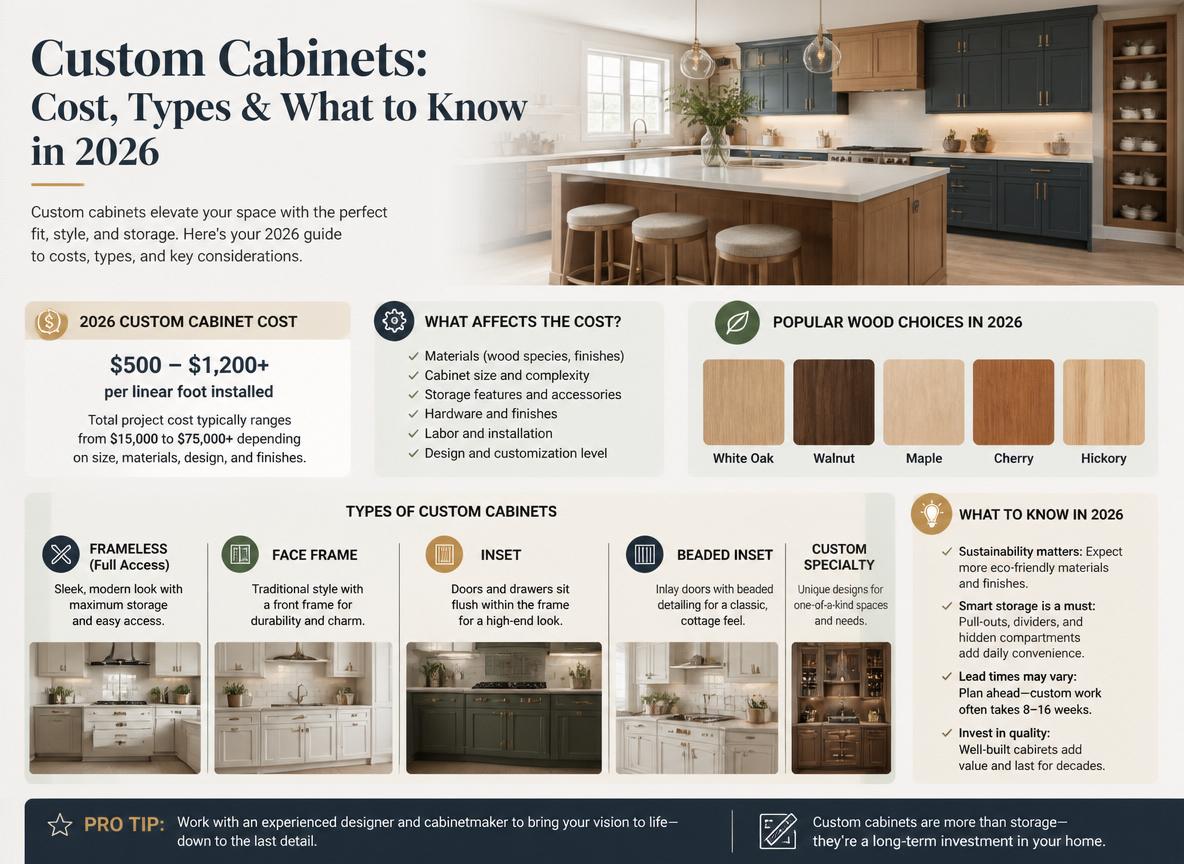
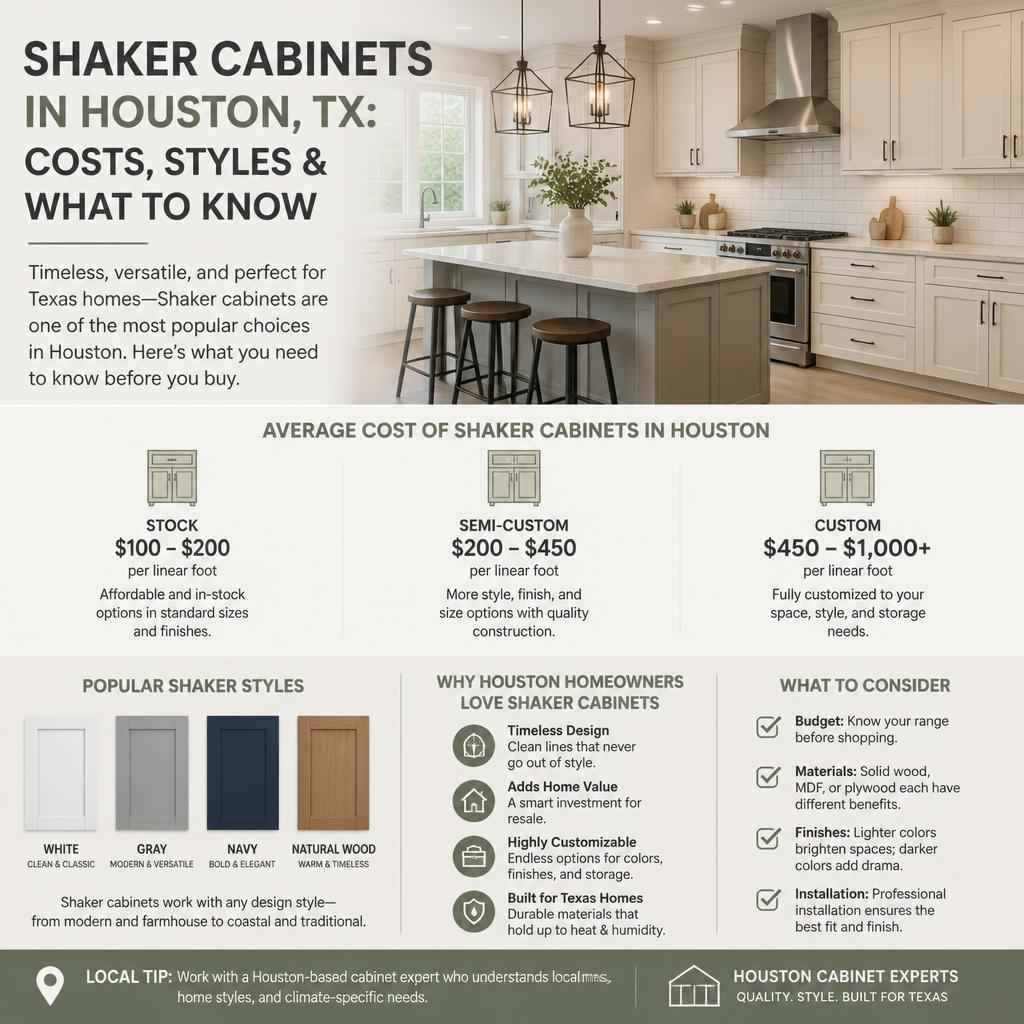
Stock cabinets are manufactured in fixed sizes, typically in three-inch width increments, and sit in a warehouse ready to ship. You pick the closest size to what you need and work around it. They’re fast, they’re affordable, and they work fine for straightforward layouts with standard proportions.
Semi-custom cabinets are built by a manufacturer but let you adjust certain dimensions and finishes within a defined range. You can usually change the depth, tweak the height, and choose from a broader palette of door styles than stock offers. What you can’t do is go outside the manufacturer’s system. If you need a 19-inch-wide cabinet, semi-custom will offer you 18 or 21, and you’ll fill the rest.
Fully custom cabinets have none of those constraints. If your kitchen has a 17.5-inch section of wall, your cabinet is 17.5 inches wide. If you want a specific interior drawer configuration that no catalog carries, it gets built. That flexibility is the whole point, and it’s why custom costs more and takes longer.
| Cabinet Type | Sizing | Lead Time | Relative Cost |
|---|---|---|---|
| Stock | Fixed standard widths | 1–3 weeks | Lowest |
| Semi-Custom | Adjustable within manufacturer’s range | 4–8 weeks | Mid |
| Custom | Built to your exact spec | 8–16 weeks | Highest |
How Much Do Custom Cabinets Cost Per Linear Foot in 2026?
The per-linear-foot model is how the cabinet trade prices almost everything, so understanding it is the first step to making sense of any quote you receive.
Linear footage is simply the total length of cabinet runs measured along the wall. A straightforward L-shaped kitchen in a typical Houston home typically has somewhere between 30 and 45 linear feet of cabinetry when you count base cabinets and uppers separately. Pantry towers and island bases are typically priced per unit rather than folded into the linear foot rate.
For fully custom cabinetry in 2026, expect installed costs in the range of $500 to $1,200 per linear foot. That range reflects both the cabinet fabrication and professional installation. Where you land within it depends on four things:
Material choice moves the needle most. Painted maple or poplar sits in a different cost band than stained walnut. Thermofoil wraps cost less than solid wood but have real limitations in Houston’s humidity, where doors can bubble or delaminate over time if the cabinet shop didn’t select the right substrate and adhesive system.
Box construction matters more than most homeowners realize before a remodel. Plywood boxes hold fasteners better over time and resist moisture more reliably than particleboard or MDF boxes. The door might look identical either way, but the box is what the hinges screw into and what carries the load of your dishes for fifteen years.
Interior features add up faster than expected. Soft-close hinges are now standard on any quality build. Pull-out trash cabinets, spice drawer inserts, blind corner pullout systems, and drawer-within-drawer configurations each add cost per unit. A kitchen with every feature maxed out can run significantly higher than the same cabinet footprint with simpler interiors.
Labor is a real factor in the Houston market right now. Skilled cabinetmakers and finish carpenters are in high demand across the Greater Houston area, and install schedules are compressed. Expect labor to represent roughly 25 to 40 percent of your total cabinet investment.
Rough Cost Ranges by Kitchen Size
| Kitchen Size | Approx. Linear Footage | Custom Cabinet Budget Range |
|---|---|---|
| Small galley or single-wall | 20–28 LF | $10,000–$34,000 |
| Average L-shape (10×12) | 35–45 LF | $17,500–$54,000 |
| Large or open-plan kitchen | 55–70 LF | $27,500–$84,000 |
| Standalone pantry cabinet | Per unit | $800–$3,500 |
These figures are starting points for budgeting conversations, not final quotes. Material costs and labor rates in the Houston area have shifted meaningfully through 2025 and into 2026. Always verify current pricing directly with your remodeling contractor before committing to a scope.
Are Custom Cabinets Worth It? Depends on the Kitchen.
This is the question most homeowners actually want answered, and most articles dodge it with vague language about “adding value.” Here’s a more honest framework.
Custom cabinets make clear sense when:
Your kitchen has layout constraints that standard sizing can’t solve cleanly. Sloped ceilings, walls that aren’t square, columns that need to be built around, or ceiling heights over nine feet all create situations where stock and semi-custom force visible compromises. Custom doesn’t.
You’re staying in the home for a long time. The payoff on quality cabinetry is measured in decades, not years. If you’re in your home for ten-plus years, a well-built custom kitchen that works exactly the way you live in it delivers value that’s hard to quantify but easy to feel every single day.
You want specific storage configurations. Kitchens that are actually organized for how a real household cooks require thought: where the sheet pans go, how the spice situation works, whether the recycling is accessible. Semi-custom offers options from a menu. Custom builds to the actual problem.
Custom cabinets are harder to justify when:
You’re remodeling to sell. Buyers don’t pay a premium that matches the cost of full custom cabinetry. A well-executed semi-custom kitchen in neutral finishes photographs beautifully and moves homes. The extra investment in fully custom construction typically doesn’t return proportionally at resale.
Your kitchen has a standard rectangular or L-shaped layout with normal ceiling heights. In that scenario, semi-custom can deliver a result that’s visually indistinguishable from custom for significantly less money and a shorter lead time.
Your total kitchen budget is under $20,000. Trying to fit custom cabinets into a tight number means cutting somewhere else, usually countertops or labor quality. That almost never ends well. A realistic semi-custom kitchen within budget beats a compromised custom kitchen every time.
Semi-Custom vs. Custom: The Honest Version
Semi-custom doesn’t mean cheap, and it doesn’t mean inferior. Brands operating in the semi-custom space produce genuinely well-built cabinetry with real finish quality and solid box construction. The limitation is the system, not the quality.
The place where semi-custom breaks down is in non-standard spaces. Gaps get filled. Walls that aren’t quite plumb create reveals that a custom build absorbs invisibly. A section of kitchen that’s an odd width gets a standard cabinet plus a filler strip, and that filler strip will always catch your eye once you notice it.
For a Houston homeowner in a typical Heights bungalow or a standard Katy subdivision home with a rectangular kitchen, semi-custom usually gets them 85 to 90 percent of the result at roughly half the cost. That math is hard to argue with.
For a Sugar Land home with a large open-plan kitchen, high ceilings, a built-in refrigerator column, and an island that needs to match exactly, custom is the only choice that looks intentional rather than assembled.
The decision isn’t about which option is better. It’s about which one your specific kitchen requires.
How Custom Cabinet Pricing Actually Works
Contractors price custom cabinetry in a way that isn’t always explained upfront. Knowing the structure helps you read quotes more accurately.
Linear foot rate covers the base cabinets and upper cabinets in standard runs. Most contractors have a base rate per linear foot that includes box construction, standard door style, and basic hardware.
Unit pricing handles anything that doesn’t fit the linear foot model: tall pantry cabinets, oven towers, appliance garages, and island bases.
Feature upgrades are typically line items: soft-close hinges, pull-out shelves, custom drawer inserts, under-cabinet lighting prep, and so on.
Finish upgrades are quoted separately. A painted finish requires more labor than a stained finish. Two-tone kitchens with a different color on the island cost more than a single-color kitchen.
Installation may be included in the quote or listed separately depending on the contractor. Always ask.
When you’re comparing quotes, make sure you’re comparing the same scope. Two quotes that look dramatically different often differ because one includes installation and one doesn’t, or one is pricing semi-custom and calling it custom.
A short checklist before you request quotes:
- Measure your linear footage for base and upper cabinets separately
- List any pantry units or specialty pieces separately
- Decide on your material tier before calling
- Know which interior features you actually need versus want
- Set your timeline, as this affects contractor availability and lead time
- Ask for itemized quotes, not lump sums
Custom Built-In Cabinets: A Different Conversation
A lot of searches for “custom cabinets near me” are actually people looking for built-in cabinetry outside the kitchen. Home office wall units, living room entertainment centers, mudroom storage systems, laundry room cabinets, and garage storage all fall under the built-in category.
These are constructed using the same methods as kitchen cabinetry, but they’re scoped and quoted differently. A kitchen remodel involves demolition, appliance coordination, countertops, and sometimes plumbing and electrical. A living room built-in is a more contained project with a narrower scope.
If you’re looking specifically for a custom pantry cabinet added to an existing kitchen, most full-service remodeling contractors handle that as either a kitchen extension or a standalone built-in project depending on whether it connects to the existing cabinet run. Budget expectations for a standalone pantry addition run $2,500 to $6,000 for most Houston-area projects, depending on height, configuration, and finish.
What to Ask a Custom Cabinet Contractor Before You Hire
The word “custom” is used loosely in this trade. Some contractors build cabinet boxes in-house from raw material. Others order from a semi-custom manufacturer, install them, and call the result custom because you chose the color. Both are legitimate businesses. They are not the same thing.
Questions that reveal the difference:
- Do you fabricate the cabinet boxes in your own shop, or do you order from a manufacturer?
- Can I visit a completed project similar in scale to mine?
- What’s your lead time from design approval to installation start date?
- Who handles the installation, your own crew or subcontractors?
- What happens if a cabinet arrives with a defect or doesn’t fit the measurement?
- Do you warranty the installation labor, and for how long?
That last question matters a lot in the first year after a kitchen install. Cabinet doors need adjustment. Hinges settle. Drawers that were perfectly aligned during installation shift slightly once the house runs through a full seasonal humidity cycle. A contractor who warranties labor comes back and fixes it. One who doesn’t will point at the manufacturer.
At Your Dream Remodeling, we include a one-year labor warranty on all installation work and handle custom cabinet projects as part of full kitchen remodels across Houston, Katy, Cypress, Sugar Land, Missouri City, and Bellaire. If you want to see real project results before committing to a conversation, the project gallery shows kitchens at multiple scales and finish levels.
Conclusion
Custom cabinets are the right choice for kitchens that demand them: non-standard layouts, specific storage requirements, long-term ownership, or a design intent that mass-produced cabinetry simply can’t match. For standard layouts on a defined budget, semi-custom delivers most of the result at a fraction of the investment.
The biggest mistake Houston homeowners make is treating “custom” as a quality signal rather than a production method. Clarify what’s actually being built before you sign anything. Know your linear footage, know your material tier, and ask the questions that separate contractors who build from those who install.
If you’re planning a kitchen remodel in the Houston area and want to explore what custom cabinetry looks like when it’s done right, contact Your Dream Remodeling for a free in-home consultation. Bring your room dimensions and your ideas. We’ll tell you exactly what makes sense for your space and your budget, without the run-around.
The right cabinets don’t just fill the room. They make the room work.
FAQ Section
What are custom cabinets?
Custom cabinets are cabinetry built from scratch to your specific room dimensions, material choices, and layout requirements. Nothing is pulled from a standard size catalog. Every measurement, door profile, interior configuration, and finish is specified for your space before fabrication begins. This makes them the only option when a kitchen has non-standard proportions, specific storage demands, or a design vision that manufactured options can’t meet.
How much do custom cabinets cost per linear foot?
Fully custom cabinetry in 2026 runs roughly $500 to $1,200 per linear foot installed, covering both fabrication and professional installation. Where you land in that range depends on material choice, box construction quality, interior features selected, and current labor rates in your market. In the Houston area, skilled installation labor is in high demand and is a meaningful portion of the total. Always get an itemized quote that separates cabinet cost from installation.
How much do custom kitchen cabinets cost for a full kitchen?
For an average L-shaped Houston kitchen with 35 to 45 linear feet of cabinetry, fully custom cabinets typically run $17,500 to $54,000 for the cabinetry itself. A complete kitchen remodel including countertops, installation, and hardware will often range from $35,000 to $80,000 or more depending on scope and finish level. These are general ranges for budget planning only. Verify current pricing directly with your contractor before finalizing a scope.
What are semi-custom cabinets and how are they different from custom?
Semi-custom cabinets are manufactured to order within a predefined system. You can adjust dimensions within the manufacturer’s available increments, usually in three-inch steps, and choose from a wider finish and door style range than stock offers. Fully custom starts from your exact specifications with no preset limits. The practical difference: semi-custom works well for standard kitchens and delivers good quality. Custom is necessary when the layout has non-standard dimensions or the storage configuration isn’t available in any catalog.
Are custom cabinets worth it?
For some kitchens, yes. For others, no. Custom makes sense for non-standard layouts, long-term homeownership, and specific functional requirements that semi-custom can’t meet. It’s harder to justify when you’re remodeling to sell, have a standard kitchen footprint, or are working with a budget that doesn’t accommodate the full investment without cutting corners elsewhere. Semi-custom often delivers 85 to 90 percent of the visual result at roughly half the cost in standard kitchens.
How do contractors price custom cabinets?
Most custom cabinet contractors price base and upper cabinet runs by linear foot, then add unit pricing for pantry towers, oven cabinets, and island bases. Feature upgrades like pull-out shelves, drawer inserts, and soft-close hardware are typically line items. Finish upgrades and painted finishes add labor cost. Installation may be included or quoted separately. Always ask for an itemized breakdown so you can compare quotes accurately and understand exactly what you’re paying for.
How long does it take to get custom cabinets?
Fabrication alone typically runs 6 to 12 weeks from design approval. Add two to three weeks for the design and measurement phase at the beginning and three to seven business days for installation at the end. Total project timeline from first consultation to a finished kitchen generally runs 10 to 18 weeks for a full custom build. If your project has a hard deadline, discuss it upfront. Some timelines aren’t compatible with full custom fabrication.
Where can I get custom-built pantry cabinets in Houston?
Full-service kitchen remodeling contractors in the Houston area typically build custom pantry cabinets as part of a kitchen scope or as a standalone built-in project. If the pantry connects to an existing cabinet run and matches the kitchen finish, it’s usually included in a kitchen remodel quote. A standalone pantry addition in a separate space is priced as a built-in project. Budget $2,500 to $6,000 for most standalone pantry builds in the Houston area depending on configuration and finish.
What’s the difference between custom kitchen cabinets and custom built-in cabinets?
Custom kitchen cabinets are the storage system in your kitchen: base cabinets, upper cabinets, the island, and specialty pieces like the pantry. Custom built-in cabinets refer to cabinetry installed in other rooms: home office shelving, entertainment centers, mudroom storage, or laundry room systems. Both use the same construction methods. Built-in projects are typically smaller in scope and priced differently than a full kitchen remodel, with less demolition and no appliance or countertop coordination involved.
What should I look for in a custom cabinet contractor?
Ask whether they fabricate cabinet boxes in-house or order from a manufacturer. Ask to see completed projects at a similar scale. Confirm their lead time from design approval to installation start. Find out whether their installation crew is in-house or subcontracted. And ask specifically about the warranty on installation labor. Door alignment, hinge adjustment, and drawer settling are common in the first year after install. A contractor with a labor warranty fixes those issues. One without a warranty often doesn’t.
How do I know if my kitchen needs custom or semi-custom cabinets?
Measure the wall widths where cabinets need to go. If all sections fall neatly within standard cabinet widths that increment in three inches from nine to thirty-six inches, semi-custom will work without visual compromises. If any section is an odd dimension, if you have high or sloped ceilings, if walls aren’t square, or if you need a storage configuration that no semi-custom catalog includes, custom is the cleaner solution. A free in-home consultation with a remodeling contractor will identify these issues before you commit to a budget.