Shaker Cabinets in Houston, TX: Everything You Need Before You Remodel
Your kitchen needs new cabinets. You’ve spent time on Houzz, Pinterest, and a few contractor sites, and the same style keeps appearing: flat recessed panels, clean lines, simple frames. That’s a shaker cabinet. And if you’re in Houston — whether you’re in Bellaire, Cypress, Richmond, or inside the Loop — it’s the style you’ll encounter most when talking to remodeling contractors, showroom designers, and real estate agents alike.
The question isn’t whether shaker cabinets work. They do, and the data backs it up. The real questions are: which version of shaker is right for your home, what does it actually cost in the Greater Houston market right now, and where do homeowners in this area consistently get it wrong? This guide answers all three.
What Are Shaker Kitchen Cabinets, Exactly?
Shaker cabinets are defined by a five-piece door construction: four frame pieces surrounding a flat, recessed center panel. That’s it. No ornate routing, no raised details, no decorative overlay. The style originated with the Shaker religious community in the 18th century and became widely adopted in American homes because of its structural integrity and visual simplicity.
What makes shaker work in almost any kitchen is the absence of detail. The door doesn’t compete with your countertop, your backsplash, or your hardware. It frames the room without dominating it — which is exactly why, according to the 2026 Kitchen Cabinet Kings ROI Report, shaker door profiles are still chosen by 58% of renovating homeowners nationally, more than flat panel (22%) and raised panel (12%) combined.
The style has evolved. Traditional shaker used rails and stiles typically 2.5 to 3 inches wide. The 2026 shift is toward Slim Shaker — narrower profiles around 1 to 1.5 inches — which reads as more contemporary without fully committing to a flat-slab look. For Houston homeowners in transitional-style homes (the dominant design preference in the area, per Houzz’s 2026 Kitchen Trends Study), Slim Shaker is the profile worth discussing with your designer.
Shaker vs. Raised Panel vs. Flat Slab: Which Fits Your Houston Home?
| Door Style | Best For | Houston Neighborhood Fit | 2026 Cost Range (Installed) |
|---|---|---|---|
| Traditional Shaker | Transitional, farmhouse, classic | Heights, Bellaire, Katy | $150–$450/linear ft |
| Slim Shaker | Contemporary-transitional hybrid | Montrose, Rice Military, Midtown | $175–$500/linear ft |
| Raised Panel | Traditional, formal | Memorial, River Oaks | $180–$550/linear ft |
| Flat Slab | Modern, minimalist | Museum District, EaDo | $125–$400/linear ft |
Pricing based on 2026 market data from Homeyou’s Houston Cost Analysis (2,801 completed projects, valid through June 2026) and local contractor estimates. Verify current pricing directly with your contractor before committing to a project budget.
The choice isn’t purely aesthetic. Houston’s humidity — averaging 75–80% year-round — puts real stress on wood cabinetry. Raised panel doors have more surface area that can absorb moisture and swell along panel joints over time. Shaker’s flat center panel and tight frame construction handles humidity more predictably, especially when finished with a high-quality paint or thermofoil.
Why Are White Shaker Cabinets Still So Popular — and Are They Still a Smart Choice in 2026?
White shaker cabinets aren’t going anywhere. But the version that dominated kitchens from 2010 to 2022 — stark bright white, cool-toned, paired with white subway tile and stainless everything — is becoming harder to sell as “timeless.”
Here’s what the data actually says. White cabinets still account for 28% of kitchen remodels nationally, according to the 2026 Houzz Kitchen Trends Study. Wood finishes edged past white for the first time in a decade at 29%. But white isn’t losing to a single competitor — it’s softening into warmer territory. Benjamin Moore White Dove, Sherwin-Williams Alabaster, and Behr Swiss Coffee are the three shades showing up most in 2026 cabinet specifications. All three read as white from a distance but carry warm undertones that pair naturally with brass hardware, stone countertops, and the wood-tone accents that are driving the broader shift in Houston renovations.
From a financial standpoint, kitchen renovations featuring white cabinetry recouped 78.6% of costs upon resale — nearly 7% higher than kitchens with wood-tone or colored cabinetry — according to Remodeling Magazine’s 2024 Cost vs. Value Report. A minor kitchen remodel returns 113% nationally on average, per the 2025 Zonda Cost vs. Value Report.
The honest trade-off: white shaker shows fingerprints, grease, and food residue clearly. In a high-use family kitchen in Cypress or Katy where four people cook, that matters. Semi-gloss and satin finishes clean more easily than flat paint but still require consistent upkeep near handles and around the stove. If you’re not prepared to wipe cabinets down weekly, a warm wood stain or a painted color may serve you better long-term.
The Two-Tone Option Houston Designers Are Recommending
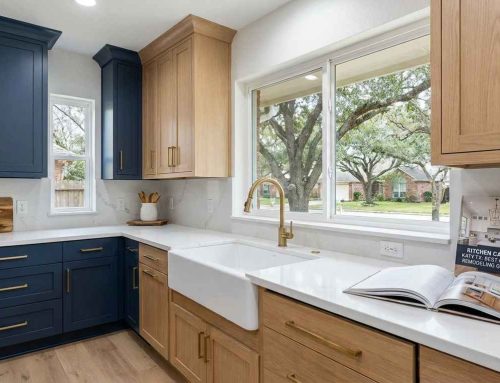
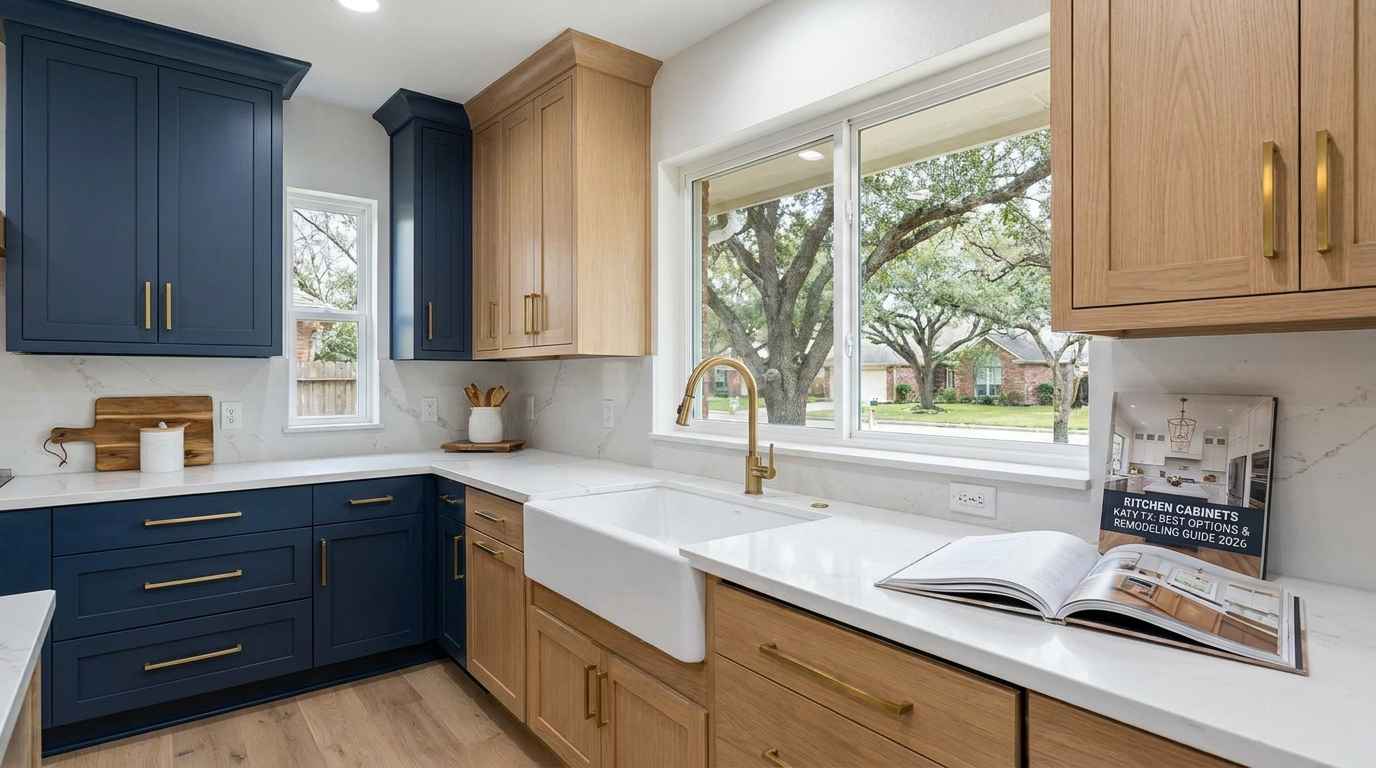
White upper cabinets paired with a contrasting lower cabinet — navy, sage green, warm wood, or black — is the configuration that thread-needles between trend and timelessness right now. White uppers keep the room bright. The lower contrast color adds personality without the full commitment of an all-colored kitchen. For homeowners in Bellaire or the Memorial area, where resale timelines matter and buyer pools are educated, this is currently the most defensible aesthetic choice.
What Does a Shaker Cabinet Kitchen Remodel Cost in Houston in 2026?
Cost is where most articles either give you numbers so wide they’re useless or so specific they’re outdated within six months. Here’s how to think about it properly for the Houston market.
Cabinet costs are measured in linear feet — the footage of wall space the cabinets occupy, not square footage of floor space. A standard 10×10 kitchen has roughly 20 to 25 linear feet of cabinet runs.
2026 Houston Cabinet Cost Ranges by Type
| Cabinet Type | Cost Per Linear Foot | Total for 20 LF Kitchen |
|---|---|---|
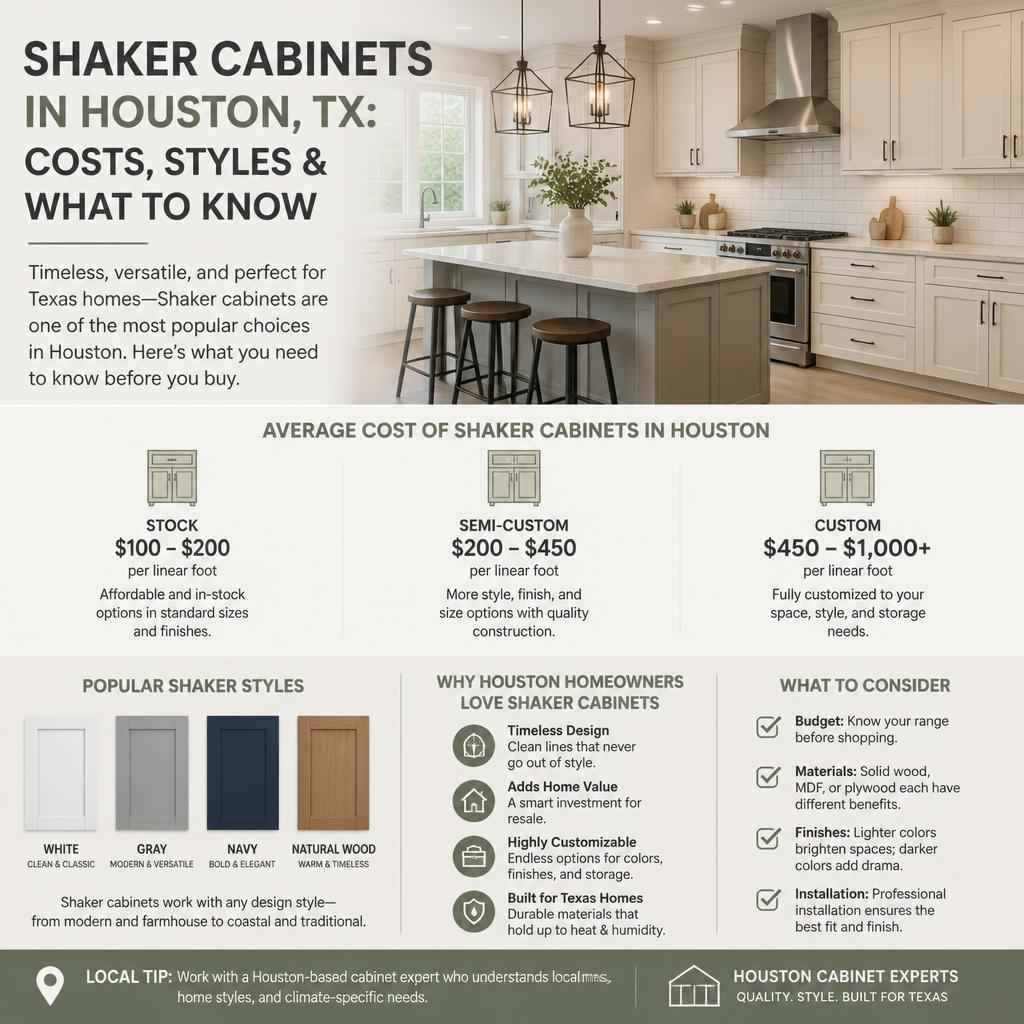
| Stock (builder-grade shaker) | $100–$300 | $2,000–$6,000 |
| Semi-custom shaker | $200–$650 | $4,000–$13,000 |
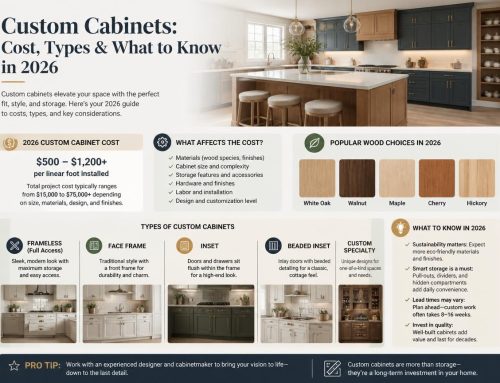
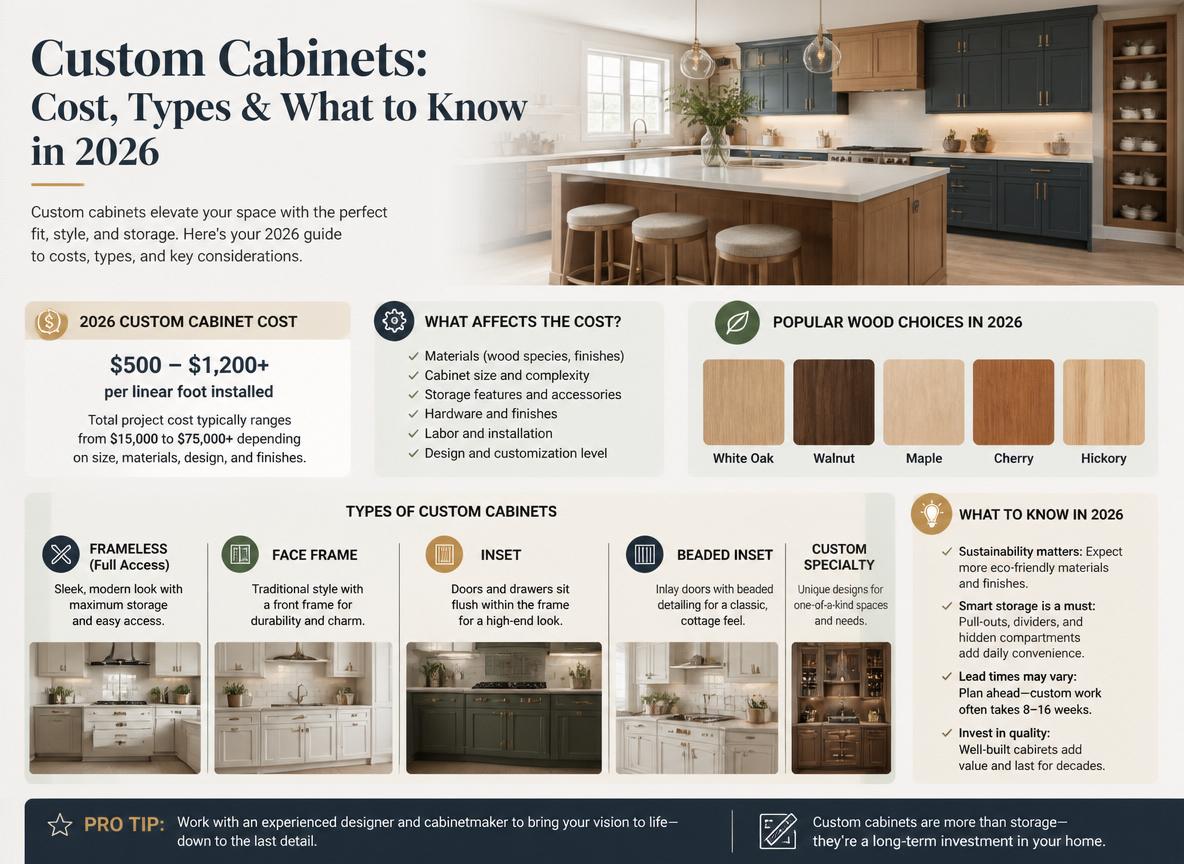
| Full custom shaker | $500–$1,200+ | $10,000–$24,000+ |
Source: 2026 Houston cabinet installation data (Homeyou, 2,801 completed projects); AMS Designer Floors Cypress market report, March 2026. Always confirm current pricing with your contractor and verify on official vendor sites before signing contracts.
For a complete kitchen remodel — cabinets, countertops, backsplash, plumbing adjustments, and installation — the Houzz 2026 Kitchen Trends Study reports a median cost of $20,000 for minor renovations and $55,000 for major projects, with large kitchens over 250 square feet running a median of $75,000 for full remodels.
The number that matters for planning: cabinetry typically consumes 30–40% of a total kitchen remodel budget, according to the National Association of Home Builders. That’s the largest single line item in most projects. Getting cabinet choice right — style, material, finish, and installer — matters more than almost any other single decision in your remodel.
Where Houston Homeowners Overspend (and Where They Don’t)
Semi-custom shaker is the sweet spot for most Houston homeowners. Full custom cabinets make sense in kitchens with unusual dimensions, built-in specialty storage, or high-end finishes where the cabinet is a design centerpiece. For a standard suburban kitchen in Cypress or Richmond, the premium rarely pays off in resale value. Stock cabinets save money upfront but limit finish options and often compromise on box construction quality — thinner panels, lower-quality hinges, less reliable soft-close hardware.
The hidden cost most homeowners don’t budget for: demolition and disposal ($500–$1,500), permit fees in Harris County ($150–$500 depending on scope), and countertop replacement, which is almost always triggered by a cabinet change because dimensions shift. Build those line items into your estimate from day one.
Where to Put Handles on Shaker Kitchen Cabinets
Hardware placement on shaker doors is one of the most common questions homeowners ask — and one of the least consistently answered by contractors. The frame-based construction of shaker doors actually gives you a clear guide.
Standard placement rules:
- Upper cabinets (doors): Pulls or knobs sit on the lower stile (the horizontal bottom frame piece), centered vertically on the stile, positioned 1 to 2 inches from the inner door edge. This aligns with how you naturally reach for an upper cabinet.
- Lower cabinets (doors): Pulls sit on the upper stile, 1 to 2 inches from the inner edge. Same principle — hardware where your hand lands naturally.
- Drawer fronts: Center pulls horizontally on the drawer front. On tall drawers (over 8 inches), use a vertical pull or two pulls stacked for better ergonomics.
- Consistency matters more than perfection: A pull that’s 2 inches from the edge on every door reads as intentional. One that’s 2 inches on some and 1.5 inches on others reads as careless.
For shaker cabinets specifically, elongated bar pulls (4 to 8 inches) work better than round knobs on most doors. The horizontal or vertical line of the pull echoes the rectangular geometry of the shaker frame. Brushed brass and matte black are the two hardware finishes that are consistently recommended across Greater Houston remodels in 2026, both for current appeal and resale flexibility.
How to Add Shaker Trim to Existing Cabinets — And When It’s Worth It
If a full cabinet replacement isn’t in your budget, converting flat-front cabinet doors to shaker style is a legitimate option. It’s not a shortcut that professional remodelers recommend universally — but for the right situation, it produces a solid result at a fraction of replacement cost.
The DIY Conversion Route
The most common approach: apply pre-made trim molding in a rectangle on the flat face of each cabinet door to simulate the shaker panel. MDF chair rail or lattice molding (typically 1/4 inch thick, 1.5 to 2 inches wide) gets cut to length, glued and pinned, then filled, sanded, primed, and painted.
What makes it work: Consistent reveals on all four sides of the simulated panel (typically 2 to 2.5 inches), proper wood filler at all corners, and two coats of primer before a semi-gloss or satin topcoat. Skipping any of these steps is where DIY shaker conversions fail — visible seams, uneven corners, or paint that chips at the edges.
What it won’t fix: If your cabinet boxes are outdated, damaged, or poorly laid out, trim molding on the doors doesn’t solve the underlying problem. In remodeling work across Houston’s inner suburbs, we see this mismatch regularly — updated door faces on tired cabinet boxes. The kitchen looks updated in photos but feels half-finished in person.
When Professional Refacing Makes More Sense
Cabinet refacing — replacing the doors, drawer fronts, and applying veneer to the existing boxes — sits between a trim conversion and full replacement. Costs typically run $4,000–$9,000 for an average Houston kitchen, compared to $10,000–$25,000+ for full replacement. The right call depends on two things: the condition of your existing cabinet boxes, and how much longer you plan to stay in the home. If the boxes are structurally sound and you’re staying 10+ years, refacing delivers a meaningful upgrade. If you’re renovating to sell within two years, full replacement typically commands a stronger return on the asking price.
Which Stores Carry White Shaker Kitchen Cabinets in Houston?
Several options serve the Houston market at different price points.
- IKEA Houston (Katy location): Stock shaker-style cabinets in white (AXSTAD and BODBYN lines). Assembly required. Price-competitive but installation is your responsibility or an add-on cost.
- Cabinets To Go Houston: Pre-assembled stock and semi-custom shaker in white, gray, and natural wood finishes. 270+ style options. Financing available. Strong option for DIYers and contractors.
- Home Depot / Lowe’s: Stock shaker in white through Hampton Bay and Diamond Now lines. Ready in days. Limited customization.
- Local cabinet manufacturers: Companies like Delta Cabinet & Doors (Houston) and Marvel-Works build custom shaker boxes and doors locally. Lead times run 3–6 weeks but deliver full customization on size, species, and finish.
- Full-service remodeling companies: Your Dream Remodeling operates a Houston showroom and design center at 1718 N Fry Rd, Suite 330, where you can walk through cabinet options with a design consultant and see finished project examples. This approach is worth the visit if you’re doing a complete kitchen or bathroom remodel rather than just swapping doors — the design consultation is free, and having one company manage selection, installation, and warranty significantly reduces the coordination burden on the homeowner.
How to Paint Shaker Kitchen Cabinets: What the Pros Do Differently
Painting shaker cabinets isn’t just rolling paint on flat surfaces. The recessed panel creates inside corners that trap brush marks. The frame construction means you’re painting wood grain running in two directions, which affects how paint adheres and how it looks under side light.
The Right Process
1. Disassemble completely. Remove all doors, drawer fronts, and hardware. Paint boxes in place, doors flat on sawhorses or a spray setup. Painting hinged doors on their frames is the most common mistake — gravity pulls the paint into drips and the hinges create shadows.
2. Clean thoroughly. Degrease all surfaces with TSP substitute or a 50/50 mix of water and white vinegar. Kitchen cabinets carry a layer of grease that’s invisible until primer reveals it as fish-eye bubbling.
3. Sand. 150-grit to scuff the existing finish, then 220-grit to smooth after the first primer coat.
4. Prime with a bonding primer. Oil-based primer over existing paint gives better adhesion than latex-on-latex. This step is not optional if you want a finish that lasts more than two years.
5. Apply paint in this order on shaker doors: recessed center panel first, then inside edges of the frame, then the four stile and rail faces. Two coats minimum. Three coats if you’re doing a dramatic color change (dark to white, or vice versa).
6. Topcoat. A water-based polyurethane in a satin sheen adds durability without looking too shiny. This matters especially in Houston kitchens where humidity and heat cycles are more aggressive than in drier climates.
The honest trade-off: Professional cabinet spray finishing (either in a shop or on-site with airless spray equipment) produces a smoother, more even finish than brush-and-roll, especially on the recessed shaker panel. If you’re investing in semi-custom or full custom shaker cabinets, professional painting is worth the added cost — typically $1,500–$3,500 for a full Houston kitchen, depending on scope.
Shaker Cabinets and Houston’s Climate: What Most Guides Skip
Houston’s subtropical environment — averaging over 50 inches of annual rainfall and humidity that rarely drops below 60% — creates real performance demands on cabinet materials that most shaker cabinet guides, written for national audiences, don’t address.
Wood species selection matters here more than in drier markets. Poplar and MDF are the most common painted-shaker door materials nationally. Both perform adequately in climate-controlled homes. But in Houston garages, laundry rooms, or kitchen spaces with inconsistent AC coverage, solid maple or plywood-core construction significantly outperforms MDF on dimensional stability.
For any shaker cabinet going into a Houston home, request plywood box construction over particleboard. Plywood holds screws better, handles humidity cycling better, and doesn’t swell and crumble at the toe-kick if the kitchen ever takes on water during flooding events — a real consideration for homes in Cypress, Richmond, and other areas with documented flood history.
Your Dream Remodeling uses quality-rated materials including moisture-resistant grout, polymer-modified adhesives, and high-grade cabinet construction across their Houston-area projects, backed by a one-year labor warranty. If a contractor can’t specify the box construction material and finish grade of their cabinets, that’s a gap worth closing before signing anything.
Making Your Final Decision: A Pre-Remodel Checklist
Before meeting with any contractor or visiting a showroom, work through these questions:
- What’s your primary goal? Daily functionality, resale value, or aesthetic upgrade? The answer changes the spec.
- What’s your realistic budget range? Stock, semi-custom, or full custom determines your options. Know which tier you’re in before the consultation.
- Are your existing cabinet boxes in good shape? If yes, refacing or a trim conversion is worth evaluating. If no, full replacement is the cleaner path.
- What’s your timeline? Stock cabinets install in days. Custom orders run 4–8 weeks. Your project timeline needs to account for this.
- Who’s managing the trades? Cabinet installation often triggers plumbing adjustments, countertop replacement, and sometimes electrical work. A full-service remodeling company manages this coordination. A cabinet-only supplier doesn’t.
- What warranty is on the labor? A one-year minimum on installation is the industry standard for reputable Houston remodelers. Ask for it in writing.
Conclusion
Shaker cabinets remain the most versatile, most resale-friendly, and most consistently chosen kitchen cabinet style in Houston — and in 2026, that position is secure. What’s changing is the color story: warm whites, two-tone configurations, and slim profiles are replacing the stark all-white formula that peaked a few years ago.
Cost-wise, plan for semi-custom shaker at $200–$650 per linear foot installed, plus the hidden line items most budgets miss: demolition, permits, and countertop replacement. Get plywood box construction if you’re staying in this market long-term — Houston’s humidity will expose cheap particleboard eventually.
If you’re ready to move from research to real numbers, Your Dream Remodeling offers free in-home consultations across Houston, Bellaire, Cypress, and Richmond. Their showroom at 1718 N Fry Rd, Suite 330, Houston, TX 77084 lets you see finished work in person before committing to anything. Call 281-550-8900 to schedule — or start online at yourdreamremodeling.com.
The right cabinet doesn’t just look good on the day it’s installed. It holds up five years from now, cleans easily, and makes the next buyer want to live there.
FAQ SECTION
Q1: What are shaker kitchen cabinets? Shaker kitchen cabinets are a five-piece door style built with four frame pieces (two stiles, two rails) surrounding a flat recessed center panel. The design originated with the American Shaker community and has remained popular for over 200 years because of its structural simplicity, ease of painting, and compatibility with virtually any kitchen aesthetic — from traditional to contemporary.
Q2: Why are white shaker kitchen cabinets so popular? White shaker cabinets are popular because they combine two things homeowners want: a clean, timeless look and strong resale value. White reflects light, making kitchens feel larger. The shaker door style doesn’t compete with countertops or backsplashes, so the overall design is easier to pull together. According to Remodeling Magazine’s 2024 Cost vs. Value Report, white cabinet kitchens recouped 78.6% of remodel costs on resale — nearly 7% more than darker or colored alternatives.
Q3: How much do shaker kitchen cabinets cost in Houston in 2026? In Houston in 2026, stock shaker cabinets run $100–$300 per linear foot installed, semi-custom runs $200–$650, and full custom can reach $500–$1,200 or more. A standard 20-linear-foot kitchen lands between $4,000 and $13,000 for semi-custom — the most common choice. Total remodel costs including countertops, backsplash, and labor range from $20,000 for minor projects to $55,000+ for full renovations. Always verify current pricing directly with your contractor, as material and labor costs change.
Q4: Are white shaker cabinets going out of style in 2026? Not exactly. Wood finishes edged past white for the first time in a decade in the 2026 Houzz Kitchen Trends Study, at 29% versus 28%. But “white” is shifting rather than disappearing — warm whites like Sherwin-Williams Alabaster and Benjamin Moore White Dove are growing while stark, cool, monochromatic all-white kitchens are declining. If you’re choosing for resale, warm white shaker with brass or matte black hardware and a contrasting island or lower cabinet remains one of the safest bets in the Houston market.
Q5: Where should handles go on shaker kitchen cabinets? On upper cabinet doors, place pulls on the lower stile, 1 to 2 inches from the inner edge — where your hand naturally reaches. On lower cabinet doors, place pulls on the upper stile at the same distance from the inner edge. Center pulls horizontally on drawer fronts; on tall drawers, use a vertical pull or two pulls for comfort. Consistency across all doors and drawers is more important than the exact measurement.
Q6: How do you turn existing kitchen cabinets into shaker style? Apply rectangular trim molding (MDF chair rail or lattice, typically 1.5 to 2 inches wide) to the face of flat cabinet doors to create a simulated shaker panel. Cut trim to size, glue and pin in place, fill corners with wood filler, sand smooth, prime with a bonding primer, and paint. Consistent reveals on all four sides (2 to 2.5 inches) and proper priming are the two steps most DIY conversions skip — and both determine whether the result looks professional or amateur.
Q7: Which stores carry white shaker kitchen cabinets near Houston? In the Greater Houston area, options include IKEA (Katy), Cabinets To Go Houston, Home Depot, and Lowe’s for stock options. For semi-custom and full custom shaker cabinets, local manufacturers like Delta Cabinet & Doors and Marvel-Works build to order. Full-service remodelers like Your Dream Remodeling carry cabinet lines through their showroom in northwest Houston and handle design, installation, and warranty as a single engagement.
Q8: Is shaker style good for small kitchens? Yes — shaker is one of the best styles for small kitchens, particularly in white or a warm off-white. The flat recessed panel doesn’t add visual weight the way raised panel does, and the clean horizontal lines don’t interrupt the eye. White shaker’s high light reflectance makes smaller spaces feel noticeably more open. In smaller Houston homes in Bellaire or Richmond where kitchen square footage is limited, shaker in white or warm cream consistently outperforms other styles in both livability and resale perception.
Q9: How long does a shaker cabinet kitchen remodel take in Houston? Timeline depends on cabinet type. Stock cabinets can be available in days and installed within 1 to 2 weeks of project start. Semi-custom orders typically run 3 to 5 weeks for manufacturing. Full custom cabinets can take 6 to 10 weeks from order to delivery. Add installation time (3 to 7 business days for a standard kitchen) and countertop fabrication and installation (typically 2 to 3 weeks after cabinet installation). A realistic semi-custom kitchen remodel in Houston runs 8 to 12 weeks from contract signing to project completion.
Q10: What’s the difference between shaker and inset cabinets? Standard shaker doors are “overlay” — the door sits over the face frame of the cabinet box. Inset shaker doors sit flush inside the face frame, like a fine piece of furniture. Inset has a more refined, custom appearance but costs significantly more (typically 25–40% premium) and demands higher installation precision. Seasonal wood movement in Houston’s climate can cause inset doors to bind or show uneven gaps over time. For most Houston homeowners, full-overlay shaker delivers the better balance of appearance, durability, and cost.