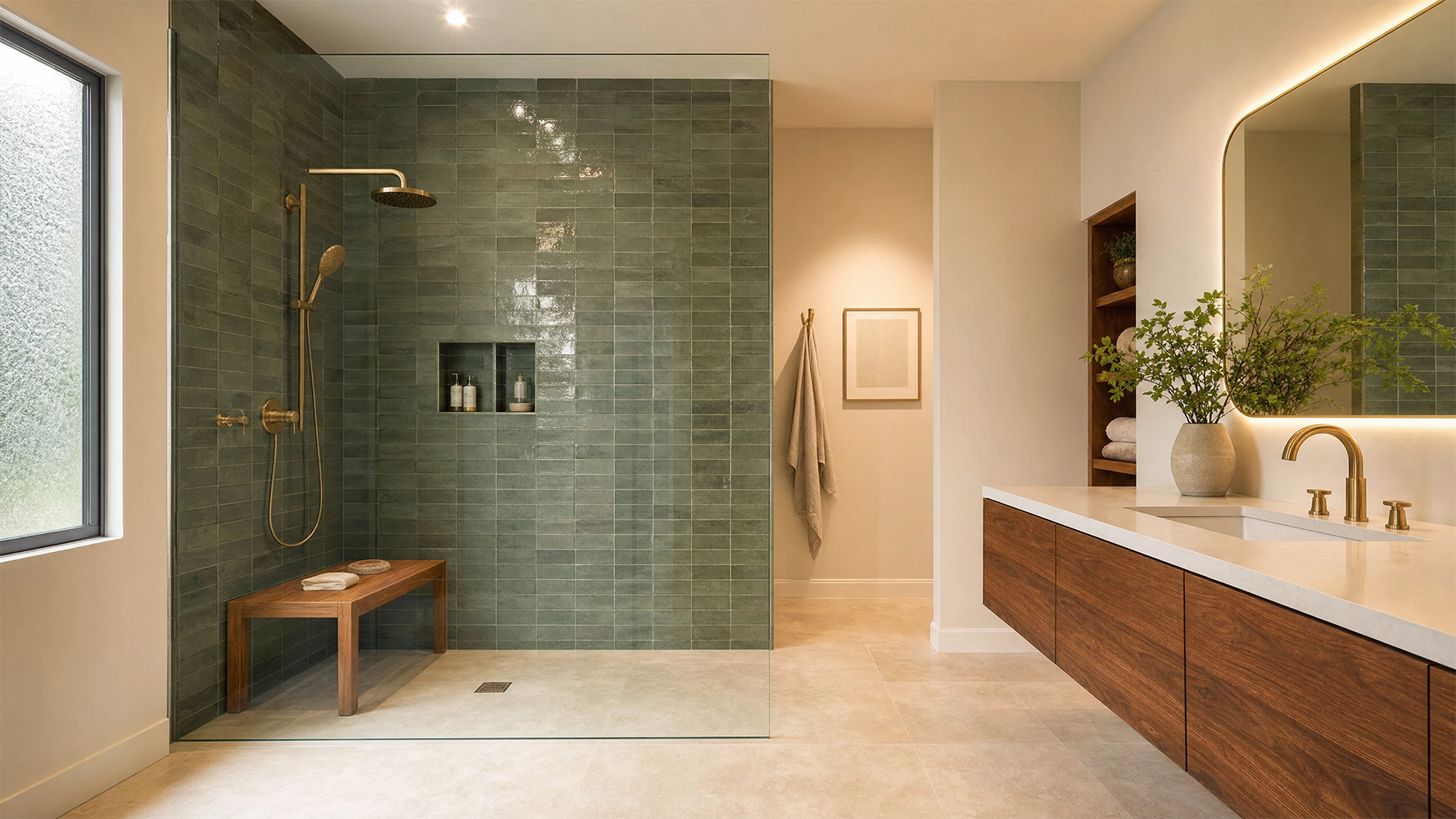
A leaking shower pan, a vanity that’s been wobbling since 2019, tile grout that no longer comes clean no matter what you scrub it with. At some point, patching stops making sense and a real local bathroom remodel becomes the only option that holds up. The hard part isn’t deciding to remodel. It’s figuring out who to trust with it, what it should actually cost in Houston’s current market, and how to tell a serious contractor from someone who’ll vanish mid-project. This guide breaks down 2026 pricing by scope, what separates legitimate local bathroom remodel companies from the rest, and the questions that protect you before a single tile gets pulled.
What Does a Local Bathroom Remodel Actually Cost in Houston Right Now?
Houston bathroom remodels in 2026 run $8,500 to $50,000, with most full bathroom projects landing between $15,500 and $35,000. The exact number depends almost entirely on whether you’re refreshing finishes or rebuilding the room from the studs out.
Houston is still one of the more affordable major metros for renovation work. Local construction costs run about 8% below the national average, which is real money on a project this size. But that discount narrows or disappears entirely inside the Inner Loop and in older neighborhoods where outdated plumbing and electrical force more invasive work.
Here’s how the numbers break down by project type:
| Remodel Type | Typical Cost Range | What’s Included |
|---|---|---|
| Cosmetic refresh | $8,500 – $18,000 | New vanity, toilet, lighting, paint, reglazed tub, basic flooring |
| Mid-range full remodel | $18,000 – $35,000 | New tile shower, semi-custom vanity, quartz counter, updated fixtures, possible heated floor |
| High-end / layout change | $35,000 – $50,000+ | Moved plumbing, custom cabinetry, freestanding tub, premium tile and stone |
| Luxury master suite | $60,000 – $90,000+ | Full structural rework, designer finishes, steam shower, custom everything |
A few cost drivers matter more than people expect going in. Labor typically makes up 40% to 65% of the total project price, which means the contractor you hire affects your budget more than the tile you pick. Skilled trade rates in the Houston area climbed roughly 4 to 6% over the past year, largely tied to a regional shortage of licensed plumbers and electricians. If your project involves moving a drain line or relocating a wall, budget separately for it. Reworking plumbing and electrical to support a new layout typically adds around $5,000 on top of standard remodel costs.
One thing competitor pricing guides consistently get wrong: most quote the same range for a half bath and a primary suite, as if a 35 square foot powder room and a 120 square foot master bath cost the same per square foot. They don’t. Smaller bathrooms actually cost more per square foot, because plumbing rough-in, waterproofing, and code-required ventilation don’t shrink proportionally with the room.
Texas Doesn’t License General Contractors. Here’s What That Actually Means for You
This is the single most misunderstood fact in Houston remodeling, and it shows up wrong on almost every contractor’s website. Texas has no state-issued general contractor license. Unlike states such as California or Florida, anyone can legally call themselves a general contractor in Texas without passing an exam or holding a state credential.
What Texas does regulate are the specialty trades. Plumbing work requires a license through the Texas State Board of Plumbing Examiners. Electrical work requires TDLR licensing. HVAC work requires a TDLR Air Conditioning and Refrigeration Contractor license. Self-performing electrical, plumbing, or HVAC work without the corresponding license is a state offense, regardless of any city-level paperwork the general contractor holds.
So when you’re vetting local bathroom remodel companies, the right question isn’t “are you licensed as a contractor.” It’s narrower and more useful:
- Who is your licensed master plumber, and can I see their TSBPE license number?
- Who pulls your electrical permits, and are they a TDLR-licensed electrician?
- Does your company carry general liability insurance, and can you provide a certificate naming me as the project address?
- Will permits be pulled in your company’s name or mine?
Any legitimate local bathroom remodel contractor answers these without hesitation. A contractor who gets cagey about subcontractor licensing, or who tells you permits “aren’t really necessary for a bathroom,” is the clearest red flag in this entire process.
Houston’s permitting process works differently than licensing. Houston requires no general contractor registration; permits are issued job-by-job through the Houston Permitting Center instead. That means your contractor needs to pull a permit for this specific project, not show you a blanket license that covers everything. If a bathroom remodel involves moving plumbing, changing electrical circuits, or altering structural elements, it needs a permit. Skipping that step to save time creates real problems at resale, when buyers’ inspectors flag unpermitted work.
How Do You Actually Compare Local Bathroom Remodel Companies?
Pull three to five quotes from contractors who’ve worked in your specific neighborhood, not just your general metro area. Houston’s soil conditions, older clay sewer lines, and humidity-driven mold risks differ enough by area that local experience changes both the price and the recommendation.
What separates a legitimate contractor from a risky one
Use this checklist before signing anything:
- General liability insurance certificate, with your project address listed
- Licensed plumber and electrician identified by name, with verifiable license numbers
- A written contract specifying start date, completion date, and payment schedule tied to milestones, not a flat deposit upfront
- A permit pulled in the contractor’s name before demo begins
- References from projects completed in the last 12 months, not five years ago
- A clear change-order process in writing for anything discovered mid-project (water damage, outdated wiring, etc.)
- No request for more than 10 to 30% as an initial deposit
That last point trips up more homeowners than anything else on this list. A contractor asking for half the project cost before work starts is a documented pattern in remodeling fraud complaints filed with the Texas Attorney General’s office. Walk away.
Showroom-based remodelers vs. subcontractor-network remodelers
There are two dominant business models among local bathroom remodelers in Houston, and they fit different homeowners.
Showroom-based design-build companies keep designers, project managers, and a physical selection center in-house, then subcontract licensed trades for plumbing and electrical. You see and touch your tile, cabinetry, and countertop options in person before committing. Pricing tends to run slightly higher than piecemeal contractors because design time and project coordination are bundled in. This model fits homeowners who want one point of contact and don’t want to source materials themselves.
Standalone general contractors typically work from a smaller materials catalog or expect you to source finishes independently, then coordinate the trade work. Pricing can come in lower upfront, but the homeowner absorbs more of the coordination burden, including tracking down delayed materials or managing a designer separately. This model fits homeowners who already know exactly what they want and have time to manage details.
Neither model is universally better. A first-time remodeler juggling a full-time job usually does better with a showroom model, where decisions get narrowed for them. A homeowner who has remodeled before and has strong opinions about finishes often gets a better price working with a standalone GC.
What Happens When the Standard Remodel Advice Doesn’t Apply to You
Most bathroom remodel guides assume a straightforward gut-and-redo. Several common situations change the math entirely, and most competitor content skips them.
You live in an older Inner Loop or Bellaire home with cast iron plumbing. Homes built before the 1970s often have cast iron drain lines that have corroded internally even when they look fine from outside. A contractor who quotes your remodel without scoping the drain line first is guessing. Add $1,500 to $4,000 to your budget contingency if your home falls into this category, and ask specifically whether the quote includes a camera inspection of existing lines.
You’re remodeling for aging-in-place needs, not aesthetics. A walk-in shower with grab bars, a comfort-height toilet, and slip-resistant flooring cost roughly the same as a standard mid-range remodel, but the design priorities flip. Curb-less shower entries require more precise slope work and usually add $1,000 to $2,500 in labor versus a standard threshold shower. Not every contractor who does standard remodels has experience with ADA-informed layouts, so ask directly about past aging-in-place projects.
You’re remodeling a rental property or investment home. The math here isn’t about your personal taste. It’s about return per dollar at resale or re-rent. The National Kitchen & Bath Association found that homeowners who invest in professional bathroom remodeling typically see a 60 to 70% return on investment at resale. For rental properties, mid-range fixtures with durable finishes (porcelain tile over natural stone, engineered quartz over marble) almost always outperform luxury upgrades on actual ROI, because tenants don’t pay premium rent for marble.
Your slab has foundation movement, which is common across Houston’s clay-heavy soil. If your bathroom floor has visible cracking or your door has started sticking, get a foundation assessment before scheduling a remodel, not after. Tiling over a shifting slab leads to cracked grout within a year or two regardless of how good the installer is. This is a step most remodel quotes skip entirely unless you ask.
Houston Bathroom Remodel by Neighborhood: What Changes and What Doesn’t
Pricing guides that quote one flat number for “Houston” miss how much local conditions shift the project. Here’s what actually varies by area within Your Dream Remodeling’s service footprint.
| Area | What Typically Drives Cost Up | What Typically Keeps Cost Down |
|---|---|---|
| Houston (Inner Loop) | Older plumbing, tighter access, stricter historic-district permitting in some pockets | N/A, generally the highest-cost zone |
| Bellaire | Larger lot sizes mean more teardown-rebuild projects with full structural changes | Newer housing stock in parts of the city reduces plumbing surprises |
| Katy | Newer subdivisions mean fewer structural surprises | Standardized floor plans make material estimating more predictable |
| Cypress | Larger suburban lots support bigger primary suite expansions | Newer construction (post-2005) generally means modern plumbing |
| Sugar Land | Higher-end finish expectations push average project cost up | HOA-approved contractor lists can speed permitting in some communities |
| Richmond / Rosenberg | More acreage properties may need septic system coordination | Lower land and labor cost baseline than Inner Loop areas |
If your home sits in a newer Katy or Cypress subdivision built after 2010, expect your remodel to skip most of the plumbing surprises that drive up Inner Loop projects. If you’re in an older Bellaire or Montrose-area home, build in a larger contingency and ask your contractor directly about what they’ve found behind walls on comparable houses nearby.
Pros and Cons: DIY vs. Hiring a Local Bathroom Remodel Contractor
| DIY or Partial DIY | Hiring a Licensed Local Contractor | |
|---|---|---|
| Pros | Lower material markup, full control over timeline, satisfying for capable homeowners | Licensed trades handle code compliance, warranty coverage on labor, faster timeline, permit handling included |
| Cons | No labor warranty, DIY plumbing/electrical mistakes are expensive to unwind, insurance may not cover unpermitted work, timeline often doubles | Higher upfront cost, less control over daily schedule, requires vetting |
| Best fit | Homeowners doing cosmetic-only updates (paint, hardware, fixtures) with no plumbing or electrical changes | Any remodel involving moved plumbing, electrical changes, waterproofing, or structural work |
The honest line here: cosmetic swaps are reasonable DIY territory. Anything touching water lines, drain slope, or GFCI circuits is where unlicensed work creates liability that follows you at resale, since most home insurance policies exclude damage from unpermitted modifications.
If you’re still deciding which category your project falls into, it’s worth doing a quick walkthrough of your own bathroom and noting what’s purely cosmetic versus what would require opening a wall. That fifteen-minute audit usually clarifies the scope before you even call a contractor.
What to Expect From the Remodel Timeline
A mid-range full bathroom remodel in Houston typically runs 3 to 5 weeks from demo to final walkthrough, assuming materials are in stock and no major plumbing surprises surface. Layout changes or custom cabinetry can push that to 6 to 8 weeks.
The phase that catches homeowners off guard most often isn’t construction, it’s the lead time on materials. Custom vanities and special-order tile can take 3 to 6 weeks to arrive, and that clock needs to start before demo, not after. Ask any contractor you’re considering exactly when they order materials relative to the demo date. A contractor who demos first and orders materials after is setting you up for a bathroom you can’t use for weeks longer than necessary.
How to Choose the Right Bathroom Remodel Contractor for Your Project
By this point you’ve got the pricing context and the vetting checklist. The decision usually comes down to three things: your budget tier, how much design support you want, and whether your home’s age suggests hidden plumbing or structural issues.
If you want a single point of contact, an in-person showroom to select finishes, and a team that already knows the older housing stock around the Inner Loop versus the newer subdivisions in Katy and Cypress, a design-build remodeler with deep local service-area experience is generally the safer bet over a standalone GC, particularly for a first remodel. Your Dream Remodeling works across Houston, Katy, Cypress, Sugar Land, Richmond, Bellaire, and the surrounding communities, with a showroom where you can see materials before committing, rather than choosing from a catalog photo.
Before you call anyone, walk your own bathroom and write down what’s actually bothering you: the layout, the storage, the finishes, or all three. That five-minute exercise makes every contractor conversation faster and more accurate, because you’ll be describing the actual problem instead of just saying “I want it updated.”
Conclusion
A local bathroom remodel in Houston in 2026 runs $8,500 to $50,000 depending on scope, with labor and trade licensing mattering more to your outcome than any single material choice. Texas doesn’t license general contractors, so the real vetting work is verifying the licensed plumber and electrician behind the quote, confirming insurance, and getting a written contract with a milestone-based payment schedule. Older homes near the Inner Loop and Bellaire carry more plumbing risk than newer builds in Katy or Cypress, and that should shape both your budget and your contractor questions. If you’re ready to get a real number for your specific bathroom, request a consultation and walkthrough rather than relying on a generic online estimate. The bathroom you’re frustrated with today doesn’t have to be the one you’re still frustrated with next year.
FAQ SECTION
1. How much does a local bathroom remodel cost in Houston in 2026? Most full bathroom remodels in Houston run $15,500 to $35,000, with cosmetic refreshes starting around $8,500 and high-end projects reaching $50,000 or more. The range depends mainly on whether plumbing or layout changes are involved.
2. Do I need a licensed contractor for a bathroom remodel in Texas? Texas doesn’t license general contractors at the state level, but plumbing, electrical, and HVAC work must be done by state-licensed trades. Always verify your contractor’s subcontractors hold valid TSBPE or TDLR licenses.
3. How long does a bathroom remodel take? A standard mid-range remodel takes 3 to 5 weeks from demo to completion. Custom cabinetry, special-order tile, or layout changes can extend that to 6 to 8 weeks.
4. Is it cheaper to remodel a small bathroom than a large one? Not per square foot. Small bathrooms often cost more per foot because plumbing, waterproofing, and ventilation requirements don’t shrink with the room size.
5. What’s included in a typical local bathroom remodel quote? A complete quote should itemize demolition, plumbing and electrical labor, materials (tile, vanity, fixtures), permits, and a contingency line for issues found once walls open. If a quote skips contingency, ask why.
6. Should I choose a showroom-based remodeler or an independent contractor? Showroom-based remodelers suit homeowners who want design help and one point of contact. Independent contractors often cost less but require you to manage materials and design decisions yourself.
7. How much should a deposit be for a bathroom remodel? A reasonable deposit is 10 to 30% of the total project cost. Any contractor asking for half the price upfront is a red flag worth walking away from.
8. Does a bathroom remodel require a permit in Houston? Yes, if the project involves plumbing, electrical, or structural changes. Houston issues permits per project rather than requiring a general contractor license, so confirm your contractor pulls one before demo starts.
9. What’s the ROI on a bathroom remodel? The National Kitchen & Bath Association puts typical ROI at 60 to 70% of project cost recouped at resale. Mid-range finishes usually outperform luxury upgrades on a pure return basis.
10. What should I check before hiring a local bathroom remodeler? Verify liability insurance, confirm licensed plumbers and electricians by name, get a written milestone-based payment contract, and ask for references from projects completed within the last year.