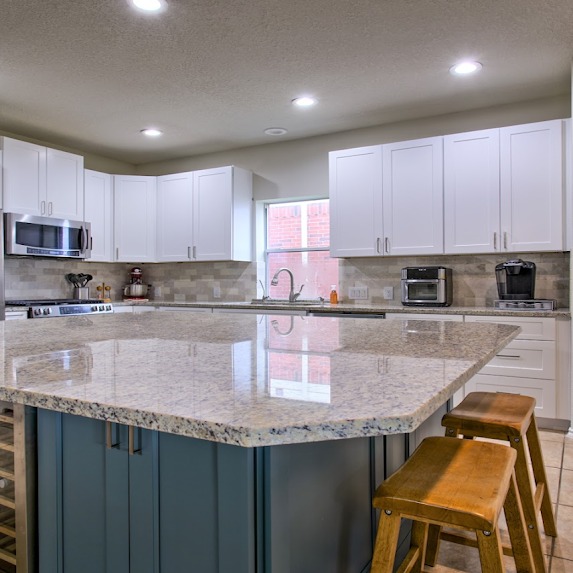
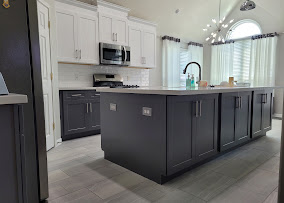
Kitchen Cabinetry in Cypress TX
Kitchen Cabinetry in Cypress TX: How to Choose Right the First Time
You’ve measured the kitchen twice, saved a dozen photos, and now you’re stuck on the part that decides everything: the cabinets. Choosing kitchen cabinetry in Cypress TX isn’t just picking a door style off a showroom wall. It’s deciding between stock and custom, figuring out which materials survive Houston humidity, and avoiding the trap of paying for upgrades that won’t matter in five years. The cabinets eat the largest slice of most remodel budgets, so a wrong call here is expensive and hard to undo. This guide breaks down the styles, the real 2026 cost ranges for the Cypress and Houston area, and the decisions that separate a kitchen that ages well from one that looks dated by the next listing photo.
What “custom cabinetry” actually means (and what you’re really paying for)
Custom cabinetry is built to your exact dimensions, material specs, and finish choices, rather than assembled from pre-sized factory units. That single difference drives both the price and the fit.
Most homeowners assume cabinets fall into two buckets. There are actually three, and the middle one is where most Cypress kitchens land.
- Stock cabinets come in fixed sizes, usually 3-inch increments. Cheapest, fastest, least flexible.
- Semi-custom cabinets start from standard boxes but allow modifications to size, finish, and hardware. The practical sweet spot for most remodels.
- Custom cabinetry is built from scratch to your space. Best for odd layouts, specific storage needs, or high-end finishes that stock lines can’t match.
In our review of remodels across the Houston metro, the homeowners who regret their choice almost always picked stock to save money, then discovered the filler strips and dead corners they accepted to make standard sizes fit. If your kitchen has an island, an awkward wall, or ceilings above nine feet, semi-custom or custom usually pays for itself in usable space.
Kitchen cabinetry styles that work in Cypress and Houston homes
The right style depends on your home’s architecture and how long you plan to stay. Most Cypress homes built since 2005 lean transitional or modern farmhouse, which narrows the field fast.
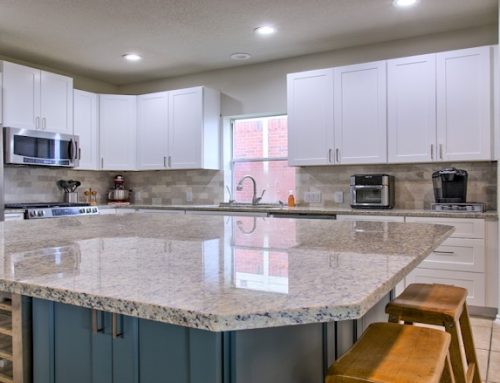
Shaker kitchen cabinetry
Shaker cabinetry is a five-piece door with a recessed flat center panel and clean square edges. It’s the safest long-term choice in this market.
Shaker works because it reads as neither trendy nor dated. It fits traditional, transitional, and farmhouse kitchens equally well. If you’re remodeling to sell within three years, shaker in white or a soft greige is the lowest-risk pick.
Transitional kitchen cabinetry
Transitional cabinetry blends traditional detailing with clean modern lines. It’s the most common request we see in the Cypress and Tomball corridor, and for good reason.
This style pairs flat or lightly detailed doors with simple hardware and neutral tones. It suits the open-concept floor plans common in newer Houston suburbs, where the kitchen flows into the living space and can’t clash with it.
Gray and two-tone cabinetry
Gray kitchen cabinetry stays popular but has shifted. The cool, flat grays that peaked around 2018 have given way to warmer greiges and greens, according to the 2025 Houzz Kitchen Trends data.
A practical move for 2026: two-tone kitchens with a darker island and lighter perimeter. It adds depth without committing the whole room to one bold color you might regret.
European kitchen cabinetry
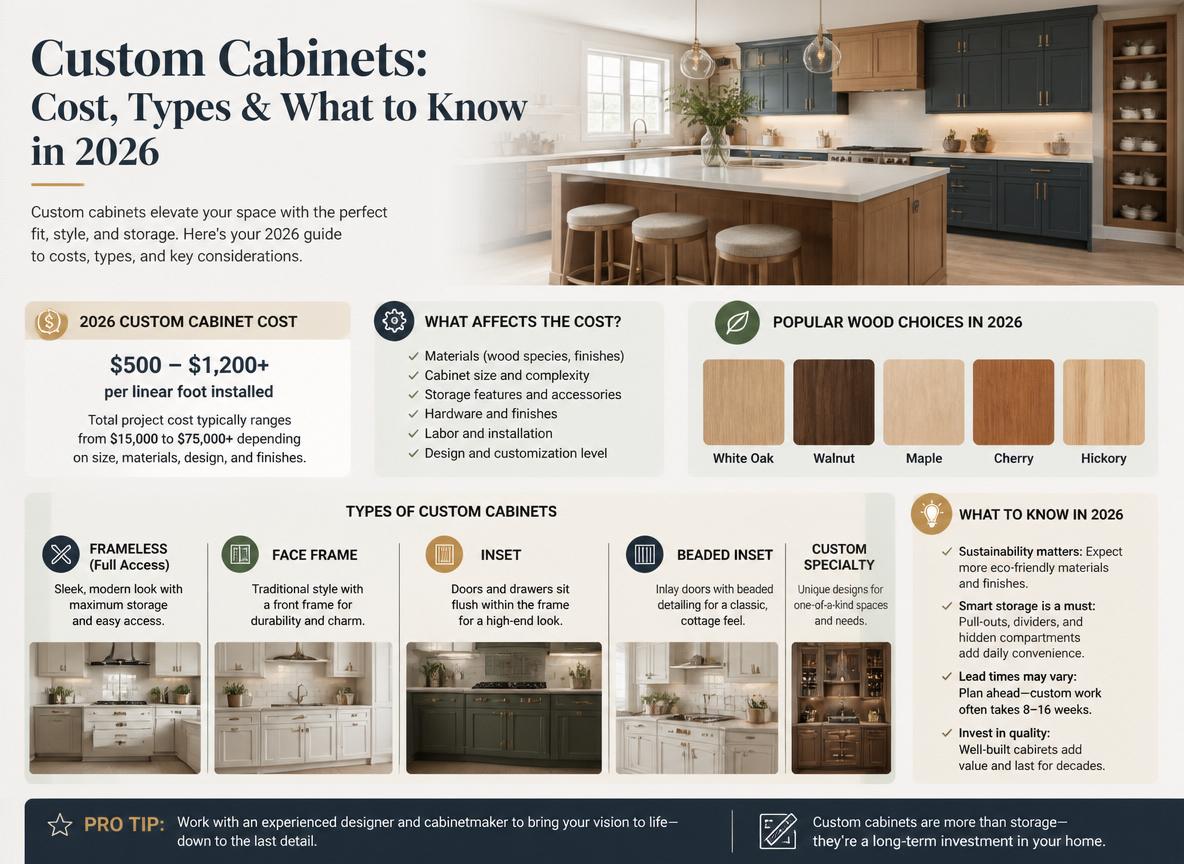
European cabinetry uses frameless (full-access) construction with flat slab doors and integrated or handleless hardware. It maximizes interior storage and delivers a flat, modern look.
This is the right choice for contemporary homes and owners who want a clean, gripless aesthetic. The trade-off: it shows fingerprints on matte and high-gloss finishes, and repairs can cost more because the components are less standardized in the US market.
Real 2026 cabinetry costs in the Cypress and Houston area
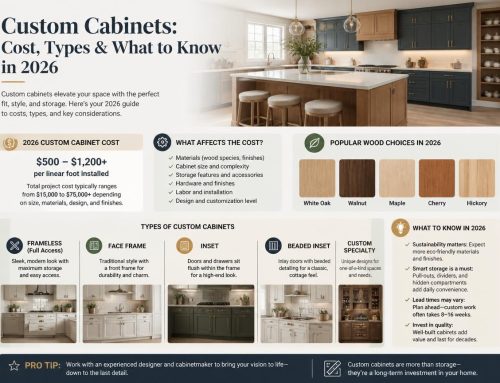
Cabinetry pricing in the Houston metro runs from roughly $200 to $1,200+ per linear foot installed, depending on construction type and materials. Here’s how that breaks down.
| Cabinet Type | Cost per Linear Foot (Installed, 2026) | Best For |
|---|---|---|
| Stock | $200 to $400 | Rentals, tight budgets, simple layouts |
| Semi-custom | $400 to $750 | Most Cypress remodels |
| Custom | $750 to $1,200+ | Odd layouts, high-end finishes, long-term homes |
| Outdoor cabinetry | $500 to $1,500+ | Covered patios, summer kitchens |
A typical 10×12 Cypress kitchen with around 25 linear feet of cabinetry lands between $10,000 and $18,750 for semi-custom installed. Custom work on the same kitchen can push past $25,000.
These ranges reflect higher 2025 and early 2026 material costs, with lumber and plywood prices still elevated above pre-2021 levels per the National Association of Home Builders. Verify current pricing with your contractor, since material costs and tariffs continue to move.
Save this table. It’s the fastest way to sanity-check any quote you receive.
The number most homeowners forget: installation, demolition, and modifications often add 30 to 40 percent on top of the cabinet boxes themselves. Budget for the full job, not the showroom sticker.
Material choices that actually survive Houston humidity
The best cabinet material for the Houston climate is plywood box construction with a quality finish, not particleboard, because plywood resists moisture-driven swelling far better.
Gulf Coast humidity is the variable most national guides ignore. Cabinets that perform fine in Denver can warp or delaminate here within a few summers.
| Material | Humidity Performance | Notes |
|---|---|---|
| Plywood boxes | Best | Worth the upgrade in this climate |
| Solid wood doors | Good | Can expand; needs stable finish |
| MDF doors | Good for painted | Stable, smooth, no grain telegraphing |
| Particleboard | Weakest | Swells if water reaches the core |
| Thermofoil | Mixed | Can peel near heat sources over time |
For painted cabinets, MDF doors are actually the smarter pick over solid wood because they won’t show seasonal expansion cracks at the panel joints. That’s a detail most showrooms won’t volunteer.
If your kitchen is near an exterior door or you run the AC conservatively in summer, prioritize plywood construction and a catalyzed or conversion finish. Both resist moisture better than standard lacquer.
Outdoor kitchen cabinetry: a different set of rules
Outdoor cabinetry must be built from weather-rated materials such as marine-grade polymer, stainless steel, or powder-coated aluminum, because standard wood cabinets fail outdoors fast. This is non-negotiable in the Texas climate.
Cypress and Houston homeowners love covered patio kitchens, but the most common mistake is installing indoor-grade cabinets under a patio cover and assuming the roof is enough protection. It isn’t. Humidity, blown rain, and temperature swings destroy wood and particleboard within a season or two.
- Marine-grade polymer (HDPE): Best all-around. Waterproof, UV-stable, easy to clean.
- Stainless steel: Premium look, pairs with grills, but shows scratches and heats up in direct sun.
- Powder-coated aluminum: Lightweight, corrosion-resistant, good mid-range option.
Skip wood entirely outdoors, even under cover. The repair cost two years later always exceeds the upfront savings.
Stock vs custom: which is right for your situation
Choose stock when budget is the hard constraint and your layout is simple. Choose custom when your space is unusual or you’re staying long-term. Semi-custom fits almost everyone in between.
Pros and cons at a glance:
Stock cabinets
- Pro: Lowest cost, fastest lead time (often in stock)
- Pro: Easy to replace pieces
- Con: Fixed sizes create dead space and fillers
- Con: Limited finish and door options
Custom cabinets
- Pro: Exact fit, any finish, maximum storage efficiency
- Pro: Best resale impression in higher-value homes
- Con: 6 to 12 week lead times common in 2026
- Con: Highest cost, harder to modify later
Here’s the honest failure scenario competitors skip: custom cabinetry is the wrong choice if you’re flipping a house or selling within 18 months. You rarely recover the premium. The 2025 Remodeling Cost vs Value Report puts midrange minor kitchen remodels at roughly 96 percent cost recovery, while upscale major remodels recover closer to 38 percent. For resale, semi-custom shaker beats custom almost every time.
If you’re unsure where you land, list how many years you’ll stay in the home before you request a single quote. That one number settles most of the stock-versus-custom debate.
How to vet a cabinetry contractor in Cypress TX
A good local cabinetry contractor gives you a written, itemized quote, shows you material samples, and provides references from recent Cypress-area jobs. Anything less is a risk.
Use this checklist before you sign:
- Licensed and insured for Texas residential work
- Itemized quote separating cabinets, install, demolition, and modifications
- Material specs in writing (plywood vs particleboard, finish type)
- Lead time committed in the contract, not “a few weeks”
- Recent local references you can actually call
- Clear warranty terms on both product and installation
- A showroom or completed projects you can view in person
- Reviews on Google and the Better Business Bureau that mention specifics
Your Dream Remodeling serves Cypress, Houston, and the surrounding suburbs with custom and semi-custom kitchen cabinetry, handling design, materials, and installation under one roof. Working with a single accountable team avoids the common gap where the cabinet supplier blames the installer and the installer blames the supplier.
Choosing the right next step for your kitchen cabinetry in Cypress TX
The decision comes down to three things: how long you’ll stay, how unusual your layout is, and how Houston’s humidity affects your material choice. For most Cypress homeowners staying five years or more, semi-custom shaker or transitional cabinetry in plywood construction is the best balance of cost, durability, and resale value. Save custom for tricky layouts and long-term homes. Skip wood entirely outdoors. If you’re ready to price your project accurately, the next move is a measured in-home consultation, which removes the guesswork that wrecks online estimates. Reach out to Your Dream Remodeling for a quote built around your actual kitchen and timeline.
Pick cabinets your kitchen will still look right in a decade, not just on install day.
FAQ SECTION
1. How much does kitchen cabinetry cost in Cypress TX? Kitchen cabinetry in Cypress TX runs from about $200 to $1,200+ per linear foot installed in 2026. Stock falls at the low end, semi-custom in the middle, and full custom at the top. A typical 25-foot kitchen costs $10,000 to $18,750 for semi-custom installed. Always confirm current pricing with your contractor, since material costs shift.
2. What’s the difference between custom and semi-custom kitchen cabinetry? Custom cabinetry is built from scratch to your exact dimensions and finish, while semi-custom starts from standard boxes with allowed modifications. Custom offers maximum flexibility and the best fit for odd layouts but costs more and takes longer. Semi-custom delivers most of the benefit at a lower price, which is why it suits most Cypress remodels.
3. Which kitchen cabinetry style is best for resale? Shaker cabinetry in white or soft greige is the best style for resale because it appeals broadly and avoids looking dated. Transitional styles also perform well in newer Houston suburbs with open floor plans. Avoid bold colors or highly specific custom designs if you plan to sell within a few years.
4. What cabinet material holds up best in Houston humidity? Plywood box construction holds up best in Houston humidity because it resists moisture-driven swelling far better than particleboard. For painted doors, MDF is more stable than solid wood and won’t crack at panel joints. A catalyzed or conversion finish adds extra moisture protection in the Gulf Coast climate.
5. Can I use regular cabinets in an outdoor kitchen? No. Outdoor kitchens need weather-rated materials like marine-grade polymer, stainless steel, or powder-coated aluminum. Standard wood and particleboard cabinets fail within a season or two outdoors, even under a covered patio, because of humidity, blown rain, and temperature swings. Indoor cabinets outdoors always cost more in repairs than they save upfront.
6. How long does custom kitchen cabinetry take to make? Custom kitchen cabinetry typically takes 6 to 12 weeks from order to delivery in 2026, depending on the shop’s backlog and finish complexity. Semi-custom is often faster, and stock cabinets can be available immediately. Build lead time into your project schedule, especially if you’re coordinating with countertop and flooring installation.
7. Is European cabinetry worth it for a Cypress home? European frameless cabinetry is worth it for contemporary homes and owners who want a clean, handleless modern look with maximum interior storage. It’s less ideal for traditional or farmhouse-style Cypress homes, and matte or gloss finishes show fingerprints. Repairs can also cost more since components are less standardized in the US market.
8. What’s the most budget-friendly way to get quality kitchen cabinetry? The most budget-friendly path to quality is semi-custom cabinets with plywood boxes and a simple shaker door. You get durable construction and a timeless look without paying full custom prices. Skip premium add-ons you won’t use daily, and put the savings into the box material, which affects longevity most.
9. Should I replace or reface my existing cabinets? Reface if your cabinet boxes are solid plywood and the layout works for you, since refacing costs far less than full replacement. Replace if the boxes are particleboard, water-damaged, or the layout wastes space. Refacing changes doors and finishes but won’t fix a bad layout or failing structure.
10. Who installs kitchen cabinetry in Cypress and Houston TX? Local remodeling companies like Your Dream Remodeling install kitchen cabinetry across Cypress, Houston, and surrounding suburbs, handling design, materials, and installation together. Choosing one accountable team avoids the common problem where a separate supplier and installer blame each other for issues. Always confirm licensing, insurance, and recent local references before signing.