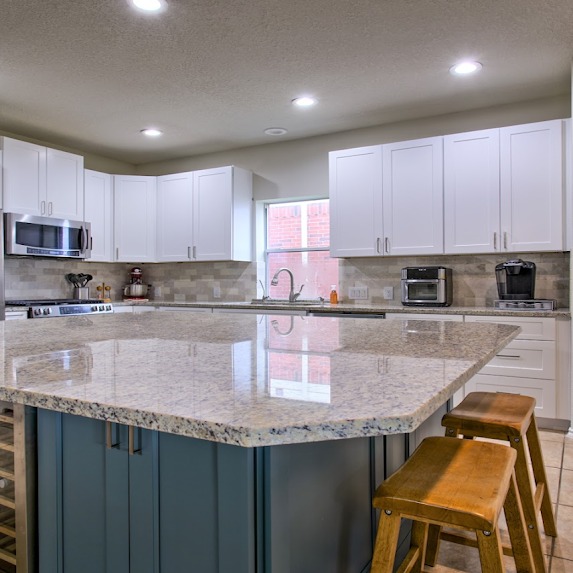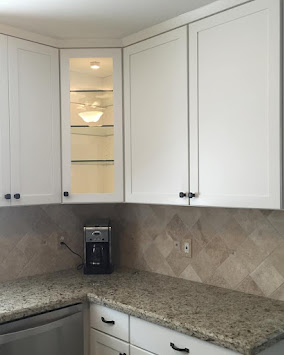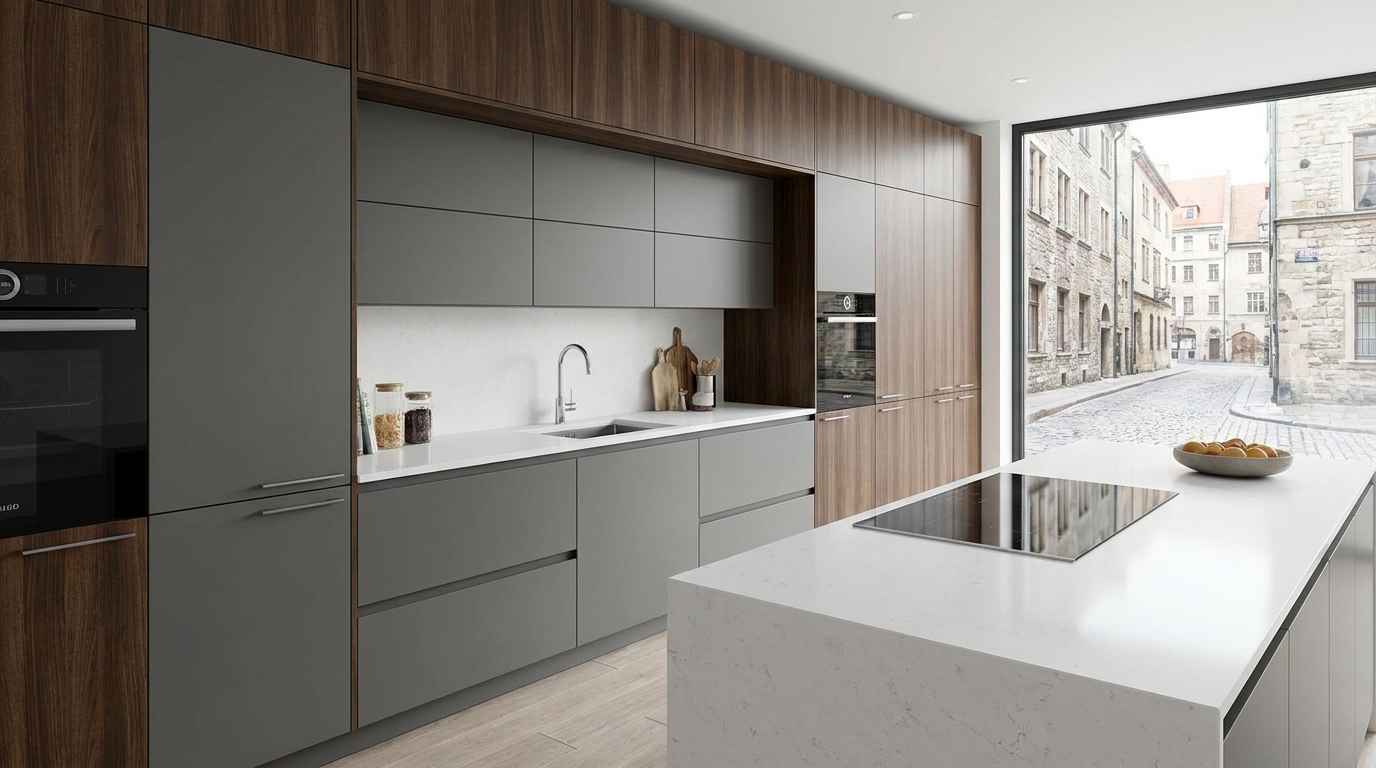
kitchen cabinetry houston texas
Kitchen Cabinetry in Houston, TX: Choosing the Right Cabinets for Your Budget, Home, and Timeline
Pull up ten Houston cabinet company websites and you’ll notice the same gap in nearly all of them: a showroom photo, a list of finishes, a phone number, and almost nothing on how stock, semi-custom, and full custom cabinetry actually differ in price or fit. That gap costs homeowners real money. Two quotes for the same kitchen can land $15,000 apart, a 1960s Bellaire ranch can reject standard-size cabinets outright, and federal tariffs enacted in late 2025 have already changed what kitchen cabinetry in Houston, TX actually costs. This guide covers all three, plus when refacing beats replacing and how to read a cabinet warranty correctly, so you walk into a consultation already informed.
What Counts as Kitchen Cabinetry, and Why Does the Category You Pick Change Everything?
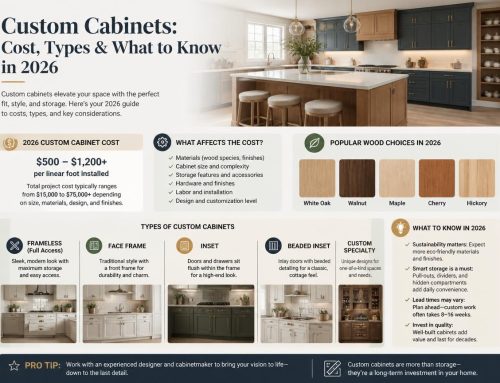
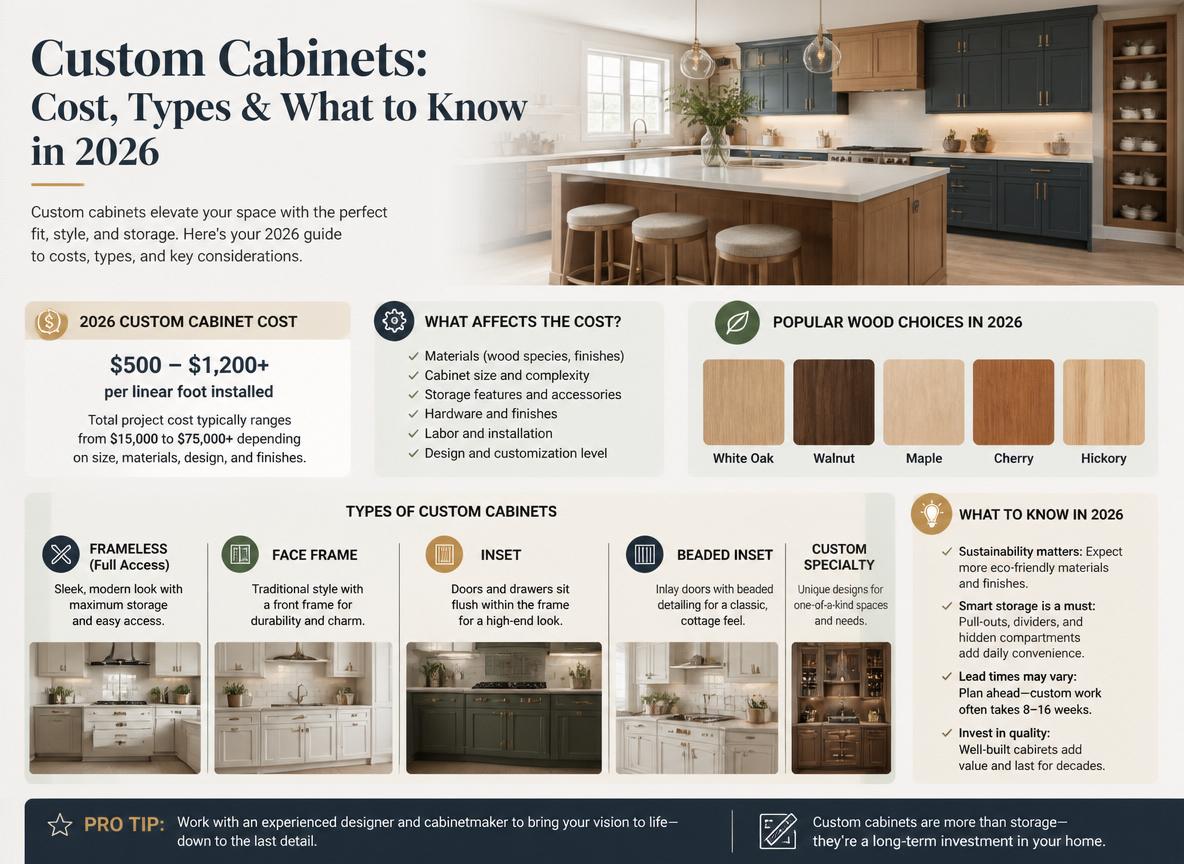
Kitchen cabinetry splits into three real categories, not the vague “custom and semi-custom” language most company pages use. Stock cabinetry is mass-produced in fixed sizes, usually 3-inch increments, shipped either pre-assembled or flat as ready-to-assemble (RTA) units. Semi-custom cabinetry starts from a manufacturer’s standard boxes but allows modified dimensions and added storage inserts. Full custom cabinetry is built from scratch to your kitchen’s exact measurements, with no size limit at all.
Why does that distinction matter more than door color? It decides your lead time, your install complexity, and whether your kitchen’s actual walls can accept what you’re buying. Homeowners who skip this step tend to find out mid-quote that their kitchen needs a category they hadn’t budgeted for.
| Category | Installed Price Range* | Lead Time | Sizing Flexibility | Typical Warranty | Best For |
|---|---|---|---|---|---|
| Stock / RTA | $3,000–$8,000 | 1–4 weeks | Fixed 3″ increments | Manufacturer warranty only, often 1–5 years | Standard-dimension kitchens, fast budget refresh |
| Semi-Custom | $8,000–$20,000 | 4–8 weeks | Modified dimensions | Manufacturer warranty (often 5–10 years) plus installer labor warranty | Most suburban Houston kitchens (Katy, Cypress, Sugar Land) |
| Full Custom | $20,000–$50,000+ | 8–16 weeks | Unlimited | Often lifetime on craftsmanship, plus installer labor warranty | Non-standard layouts, older homes, high-end finishes |
*General U.S. market estimates for cabinetry only, before 2025–2026 tariff impacts discussed below. Confirm current pricing with your contractor directly.
Budget vs. High-End Kitchen Cabinetry in Houston: What Are You Actually Paying For?
Spend five minutes in a showroom, and budget versus high-end cabinetry looks like a question of door style. Spend five years living with the kitchen, and it’s a question of box construction, hardware, and finish durability: the parts a quick walkthrough never shows you.
What “Budget” Buys You
Budget kitchen cabinetry in Houston typically means stock or entry-level RTA units, with particleboard or thin MDF boxes, standard (non-soft-close) hinges, and a laminate or thermofoil door finish. For a rental property or a flip on a tight margin, that’s a sound call. For the kitchen you’ll use daily for the next two decades, it’s a weaker one, mainly because of what happens to that box material over time.
What “High-End” Buys You
High-end kitchen cabinetry swaps the box for furniture-grade plywood, adds dovetail-joined drawers and soft-close hardware, and finishes doors in painted or stained solid wood. Most of that added cost funds durability you won’t notice until year five or six, not the visual difference you notice on day one. In a Memorial or River Oaks kitchen where cabinetry doubles as a long-term asset, that trade-off usually pays off.
Most Houston homeowners land somewhere in between. That’s the gap semi-custom cabinetry exists to fill.
Does Houston’s Humidity Actually Affect Cabinet Quality?
Yes, and it’s a material question, not a sales pitch. Particleboard cabinet boxes absorb moisture from steam, spills, and under-sink leaks, and once they swell, the damage doesn’t reverse. Plywood’s cross-grain construction resists that swelling far better, which is why a number of higher-end Houston cabinet shops now market “no MDF, no particleboard” as a selling point rather than a footnote.
The risk shows up twice in a typical project, not just in the finished kitchen. Cabinets often sit in a garage or on a covered patio for a few days between delivery and installation, and that gap exposes them to more ambient humidity here than in a drier climate. Plywood-box cabinetry shrugs that off. Particleboard often doesn’t.
Most Houston cabinet company pages skip box material entirely and jump straight to door finishes and colors. Before signing anything, ask what the box, not the door, is made of, and get the answer in writing.
Why Won’t Stock Cabinets Fit Some Houston Kitchens, No Matter the Budget?
Because the kitchen’s physical dimensions decide that, not your budget number. This shows up constantly in older Houston neighborhoods, including the Heights, Montrose, and pockets of Bellaire, where homes built before the 1970s often have 7-foot ceilings, narrower wall runs, or galley layouts that don’t match modern 3-inch modular sizing.
When that happens, stock cabinets don’t just look slightly off. They leave gaps no filler strip fully hides, or they don’t fit the run at all. At that point, the “budget” option stops being cheaper once you add the corrective carpentry, and semi-custom becomes the honest price comparison, not the upsell.
A $4,000 stock quote against an $11,000 semi-custom quote in a standard Katy or Cypress kitchen is a real decision worth weighing. The same comparison in a 1965 Bellaire ranch with an 11-foot, 4-inch wall run usually isn’t a choice at all. The stock option may not be buildable without compromises most homeowners wouldn’t accept once they saw them installed.
Are Kitchen Cabinet Prices Really Going Up in 2026?
For imported stock and RTA lines, yes, and the timeline is specific enough to verify yourself. A 25% Section 232 tariff on imported kitchen cabinets and vanities took effect May 14, 2026, under a presidential proclamation citing national security concerns tied to wood product imports. The rate was originally set to double to 50% on January 1, 2026. In January 2026, the administration delayed that increase by a year, pushing the 50% rate to January 2027 instead, according to trade reporting from the Decorative Hardwoods Association.
What Changed, and Why It Matters to You
The 25% rate is what’s in effect right now, and it lands hardest on imported stock and RTA cabinetry, the category most often sourced overseas. Domestically manufactured semi-custom and full custom lines are largely shielded from this specific increase. A separate 10% tariff on imported softwood lumber stacked on top, and U.S. hardwood plywood imports grew roughly 25% in value through September 2025 as suppliers shifted sourcing toward Indonesia and Vietnam.
How to Budget Around It
Houzz’s 2026 U.S. Kitchen Trends Study found that 85% of kitchen renovation projects already include cabinet upgrades, which means most homeowners mid-project didn’t plan for this cost shift. If your budget is tight and you’re leaning toward an imported stock line, ask directly whether your quoted price is locked, and for how long. A written hold period protects you more than a verbal assurance does.
| Cabinet Tier | 2024 Baseline | Current Reality (2026, 25% tariff in effect) |
|---|---|---|
| Stock (imported) | ~$3,000 | Often $3,750–$4,500, depending on sourcing country |
| Semi-Custom (domestic) | ~$10,000 | Largely stable; minor pass-through on imported hardware |
| Full Custom (domestic) | ~$25,000+ | Largely stable; lumber and hardware cost pass-through only |
Should You Reface Your Cabinets Instead of Replacing Them?
Reface if your existing boxes are sound. Replace if they aren’t, or if you need a different layout. Refacing keeps your current cabinet boxes in place and replaces only the doors, drawer fronts, and visible surfaces, typically for 30–50% less than full replacement, in days rather than weeks. It’s the option budget-focused searches almost never surface, largely because refacing specialists rarely rank for “kitchen cabinetry” the way replacement contractors do.
Refacing only works if the boxes underneath are structurally sound and free of water damage, so confirm that before getting attached to the idea. Run through this checklist first:
- Open every door and drawer. Square boxes that glide smoothly with no swelling or delamination are good refacing candidates.
- Check under the kitchen sink specifically. It’s the most common spot for hidden moisture damage in Houston kitchens.
- Confirm you’re happy with the existing layout. Refacing doesn’t change your floor plan. A layout change puts you back in semi-custom or custom territory.
- Get the box material confirmed, not assumed. Plywood boxes reface well. Particleboard that’s already absorbed moisture usually doesn’t.
- Compare the refacing quote against semi-custom, not against full custom. The real competition for your budget sits closer than it looks.
How Do You Actually Choose a Kitchen Cabinetry Company in Houston?
Match the company to what you’re buying, not to whoever ranks first in search results. Full-service design-build remodelers handle measuring, design, ordering, and installation under one contract, with a single point of accountability if something doesn’t fit. Standalone cabinet dealers and RTA suppliers often sell at a lower sticker price, but leave installation and design coordination to you or a separate contractor.
A full-service remodeler tends to make more sense when:
- You want one company accountable for design, ordering, and installation, with no finger-pointing if measurements are off
- Your kitchen has a non-standard layout, like the older-home scenario above
- You want financing bundled with the work
- You’re combining cabinetry with countertops, flooring, or a full kitchen remodel in the same project
A standalone cabinet dealer or RTA supplier can fit better when:
- Your kitchen has standard dimensions and you’re comfortable managing installation yourself
- Budget is the dominant constraint and you can absorb the project-management work
- You’re doing a single-room refresh, not a full remodel
Cabinet Warranty vs. Labor Warranty: The Distinction Almost No Page Explains
These are two separate promises, and mixing them up is the single most common confusion buyers run into. A cabinet warranty, issued by the manufacturer, covers defects in the boxes, doors, and hardware themselves, and on full custom solid-wood cabinetry it can run for the lifetime of the product. A labor warranty, issued by your installer, covers the quality of the installation work, things like alignment, fit, and finish, separately from the product itself.
A one-year labor warranty paired with a strong manufacturer product warranty isn’t automatically weaker than a company advertising a “lifetime warranty” that’s really just describing their own handmade product’s craftsmanship guarantee. Ask both questions before comparing two quotes side by side: what does the labor warranty cover, and separately, what does the manufacturer warranty on the actual cabinets cover.
Your Dream Remodeling, a Houston-based kitchen and bath remodeling company and Best of Houzz award winner with membership in the Greater Houston Builders Association, backs its installations with a one-year labor warranty paired with manufacturer-backed cabinet warranties, plus free in-home consultations across Houston, Katy, Cypress, Sugar Land, Richmond, Missouri City, and Bellaire.
Making the Call
Match the category to your kitchen’s actual walls, not just your target budget. Standard-dimension kitchens in newer Houston-area builds can usually go stock or semi-custom without compromise; older homes with non-standard dimensions usually can’t, no matter what the first quote implies. Factor in 2026’s tariff-driven pricing on imported lines, confirm box material before anything else, and ask the labor-warranty-versus-product-warranty question before comparing two numbers side by side.
If you’ve read this far, you already know more than most homeowners do walking into a kitchen cabinetry consultation in Houston, TX. The next useful step isn’t another spec sheet. It’s getting your specific kitchen measured by someone willing to tell you, honestly, which category it actually qualifies for.
FAQ SECTION
1. What’s the difference between stock, semi-custom, and custom kitchen cabinetry? Stock cabinets come in fixed factory sizes, semi-custom uses standard boxes with modified dimensions, and full custom is built entirely to your kitchen’s measurements. Semi-custom covers most standard Houston kitchens. Full custom becomes necessary when your space has non-standard dimensions stock and semi-custom sizing can’t accommodate.
2. How much does kitchen cabinetry cost in Houston, TX? Installed costs generally run $3,000–$8,000 for stock cabinetry, $8,000–$20,000 for semi-custom, and $20,000–$50,000-plus for full custom, before 2025–2026 tariff adjustments on imported lines. Get a written, dated quote, since pricing on imported categories is currently time-sensitive.
3. Is budget kitchen cabinetry worth it for a Houston home? It depends on your timeline. Budget stock or RTA cabinetry suits rental properties or short-term ownership plans well, but particleboard box construction holds up poorly against Houston’s humidity over a 15-to-20-year stretch. For a primary residence, semi-custom with plywood boxes is usually the better long-term value.
4. Why do some Houston kitchens reject stock cabinets entirely? Older homes in neighborhoods like the Heights, Montrose, and parts of Bellaire often have non-standard wall widths or ceiling heights that don’t match stock cabinetry’s fixed 3-inch sizing increments. In these cases, semi-custom or full custom isn’t an upgrade; it’s often the only option that physically fits the space.
5. Are kitchen cabinets getting more expensive in 2026? Yes, specifically imported stock and RTA lines. A 25% tariff on imported kitchen cabinets took effect in October 2025, with a planned increase to 50% delayed to January 2027. Domestically manufactured semi-custom and custom cabinetry are largely insulated from this particular cost increase.
6. Should I reface my cabinets or replace them? Reface if your existing cabinet boxes are square, free of water damage, and you’re happy with your current layout. It typically costs 30–50% less than replacement. Replace if you want a different layout, more storage configurations, or your boxes already show swelling or moisture damage, especially under the sink.
7. What cabinet box material holds up best in Houston’s climate? Furniture-grade plywood holds up best against Houston’s humidity, thanks to cross-grain construction that resists the swelling and warping particleboard and standard MDF are prone to. Always ask what the box, not just the door, is made of before purchasing.
8. How long does kitchen cabinetry take to install in Houston? Stock cabinetry typically installs within 1–4 weeks of ordering, semi-custom within 4–8 weeks, and full custom within 8–16 weeks, depending on current manufacturer lead times. 2025–2026 tariff-related sourcing shifts have added some unpredictability to imported-line lead times specifically.
9. What’s the difference between a cabinet warranty and a labor warranty? A cabinet warranty, from the manufacturer, covers defects in the boxes, doors, and hardware, sometimes for the product’s lifetime on full custom lines. A labor warranty, from your installer, covers the quality of the installation itself. Always ask about both separately; a shorter labor warranty paired with a strong product warranty isn’t automatically the weaker deal.
10. What questions should I ask before buying kitchen cabinetry in Houston? Ask what the cabinet box material is, get the labor warranty length in writing separately from the manufacturer’s cabinet warranty, and confirm whether your quote is locked against near-term tariff or material cost changes. Also confirm whether your kitchen’s dimensions are standard enough for stock or semi-custom, or whether you’ll need custom sizing.